The "Islamabad Talks" highlight a growing contradiction in modern diplomacy where journalists are physically present but denied direct access to negotiations. The pressure on transparency appears set to intensify as reporters are forced to trade traditional eyewitnessing for outside investigation and geopolitical speculation.
The Paradox of Presence Without Access
What does "being there" really mean for journalists when access is limited and restricted to the confines of a dedicated media space?
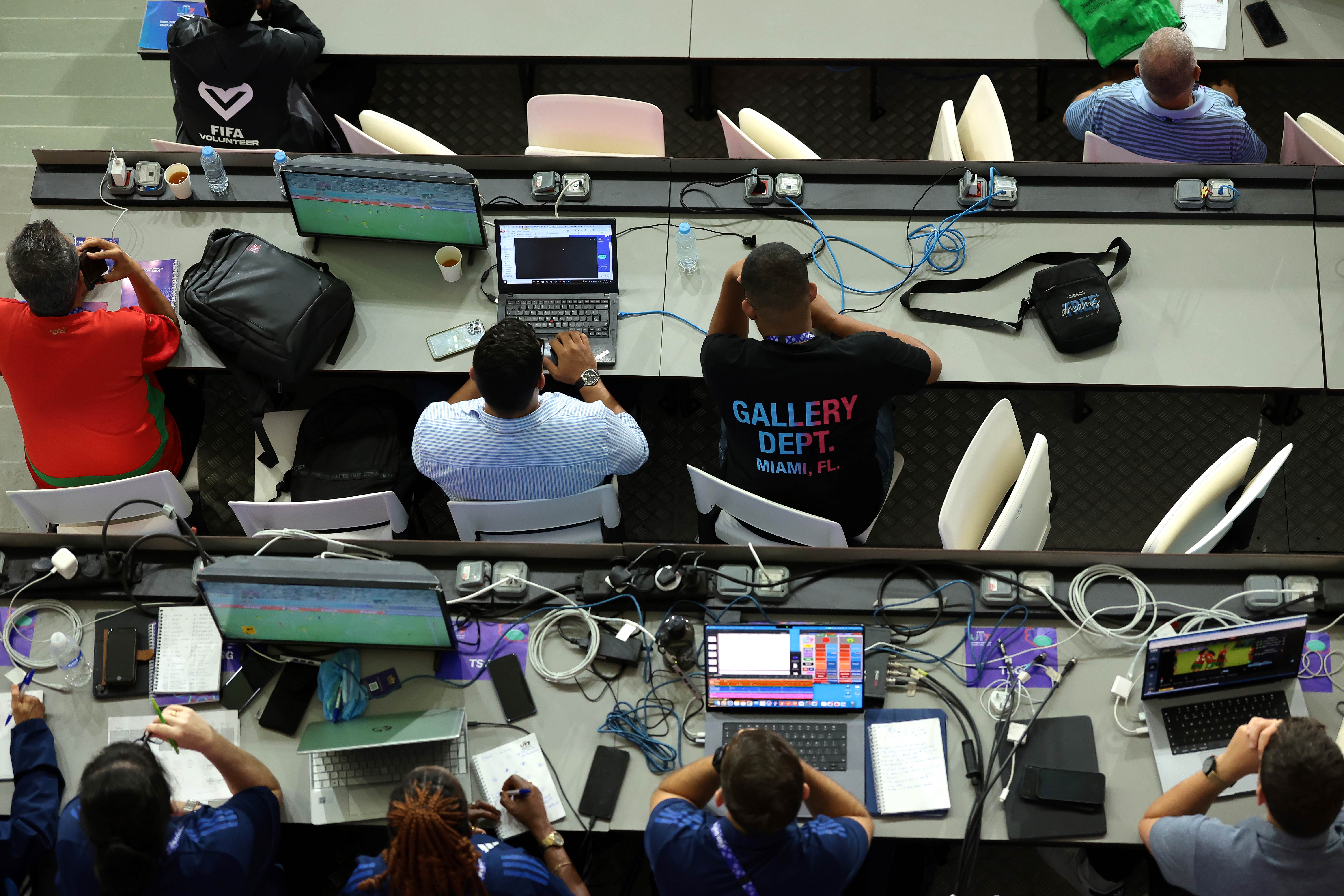
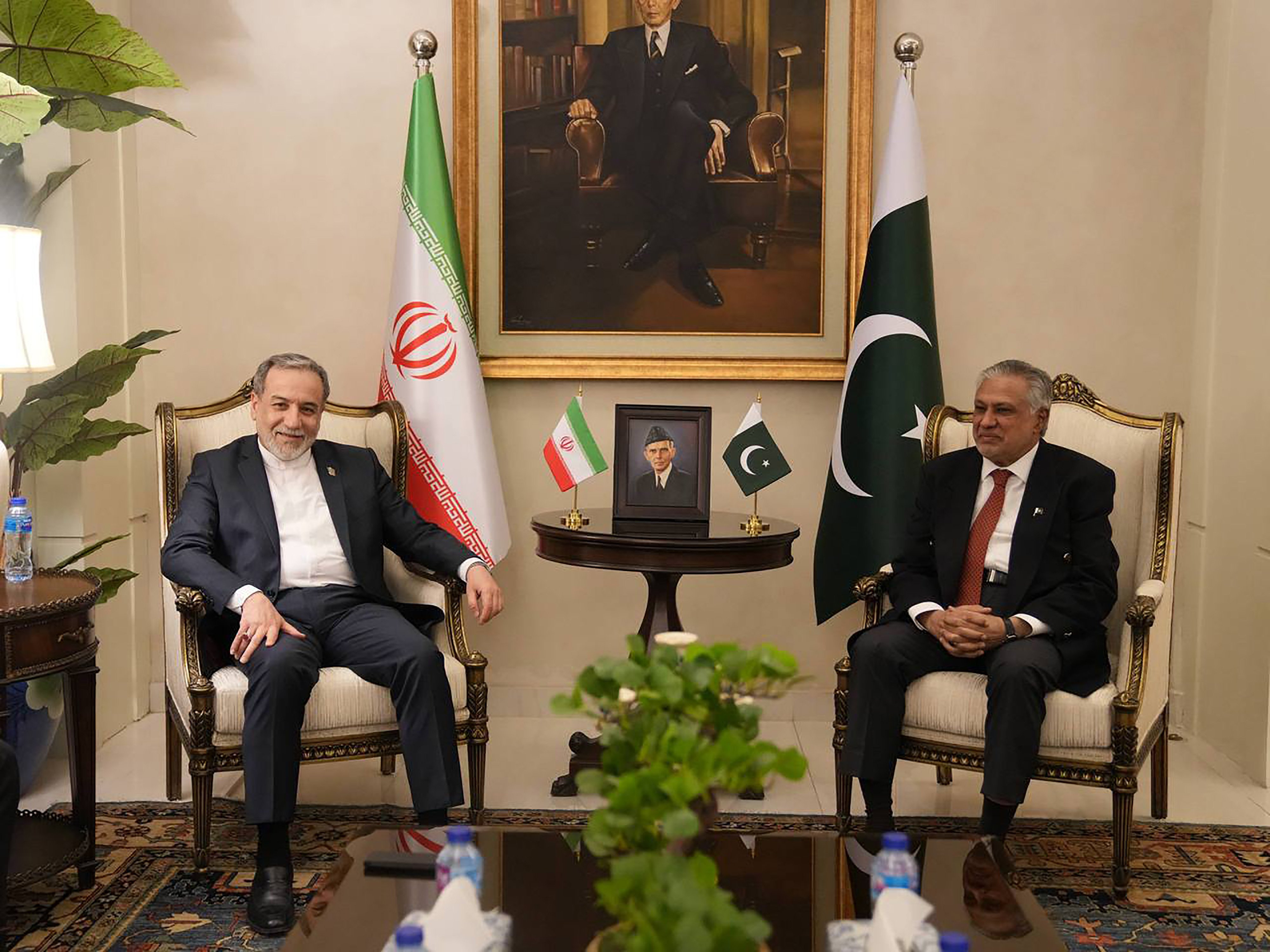
That question came into sharp focus during the US-Iran peace talks in Pakistan, widely referred to as the Islamabad Talks. As delegations met behind closed doors in the capital, hundreds of journalists from across the world gathered at a designated media hub, set up by the Ministry of Information and Broadcasting. The facility, housed inside the Jinnah Convention Centre, sat just across the prestigious Serena Hotel, where the negotiations were taking place.
It was a good vantage point of the Serena Hotel for our camera position, said James Neish, Asia One news anchor. However, he added that not being able to see delegates entering or leaving made it difficult to get a feel for myself of how it really is going.
That idea of a "feel" points to a long-standing belief in journalism that physical presence strengthens eyewitness authority. Being on the ground is meant to mean direct observation, nuance, and depth in reporting.
But at the Islamabad Talks, presence did not translate into access. Tight security blocked direct engagement, while delays and control over information shaped how events were understood in real time.
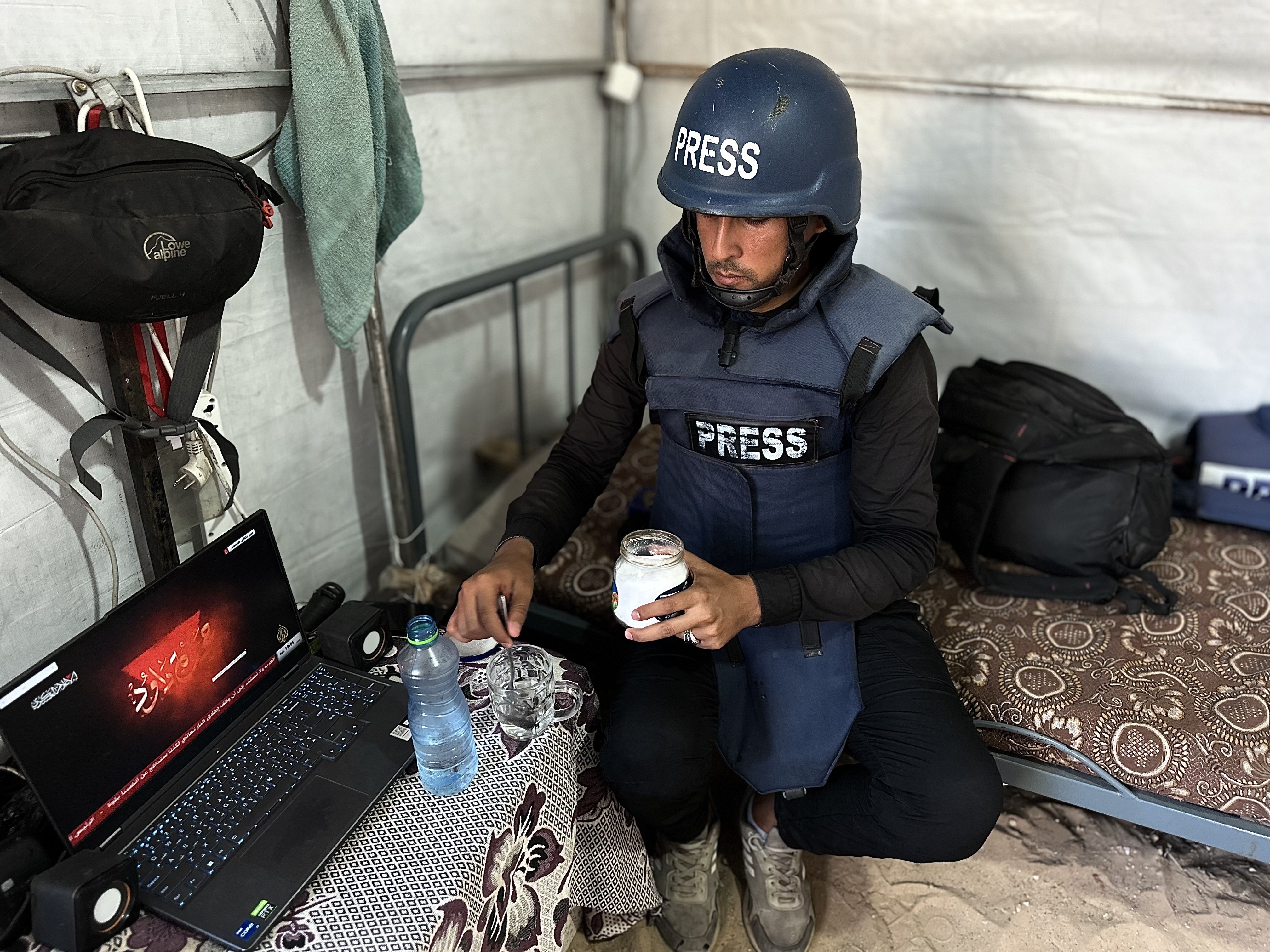
"Everyone was constantly on standby, checking their phones, refreshing feeds, and discussing possible developments with analysts," said Hamza Yaqoob, associate producer, managing international affairs at Hum News in Islamabad. He described an atmosphere defined by anticipation and uncertainty. "There were long periods of silence."
Ayesha Mir of Pakistan TV Digital said, "Everyone was waiting to hear how the talks were going and how they were going to end." While the media facilitation centre offered workstations, stable Wi-Fi, large TV screens, and endless coffee and lavish food arrangements, Mir noted that 'the only official information came at the very end, so there was no real ‘access’ to information at the centre itself.'
Well, one might ask, what is the point of "being there" if much of what matters can be followed from a screen back home?
Yet physical proximity still produced a different kind of immediacy, a kind of thrill. Not informational, but atmospheric. Senior and local journalists worked side by side in a shared space of waiting, uncertainty, and speculation over decisions with global consequences.
"It was a good venue for everyone to gather and share updates from their own sources. It also gave one the satisfaction of knowing that no one knew more than the other. We were all in it together," Mir reflected.
In high-level diplomatic situations, such constraints are part of the terrain.
"Diplomacy has its own rhythm, almost its own language," said James Neish.
This pattern was not unique to the Islamabad Talks.
The Architecture of Restricted Access
At the 2018 US–North Korea summit in Singapore, around 3,000 journalists were stationed at the F1 Pit Building, several miles away from the actual negotiations between Donald Trump and Kim Jong Un at the Capella Hotel. For coverage, journalists relied on live screens and brief official statements, while the substance of talks remained out of reach.
Similarly, at global forums such as the G20 summits, access is tightly controlled. Leaders appear in staged photo opportunities, while negotiations unfold behind closed doors. Journalists are then left to piece together outcomes with very little direct access.
Another example of diplomats and journalists operating in carefully separated spaces was during the 2015 Iran nuclear talks in Vienna. Journalists from multiple countries camped outside the Palais Coburg Hotel, where discussions were underway, and relied on glimpses of delegates and brief official readouts to shape their reporting.
It is often the host government that defines the boundaries of journalistic access, determining what is made public and what remains inside negotiation rooms.
Since this event was sensitive, Pakistan was playing a critical role, and the whole world’s eyes were on us, we had to be even more careful of what we reported. We had to sacrifice our journalistic urges for the greater good," said Ayesha Mir. But she also added that "a journalist always wants unrestricted access to information, and our job is to find sources.
When direct verification becomes difficult, reporting does not stop. It simply shifts. Limited access opens space for what is often described as "write-around" or "outside-in" reporting, where stories are constructed through interviews, documents, eyewitness accounts, and wider networks of information rather than those controlling the official narrative.
As James Neish perfectly put it, "It’s like building a puzzle, and all the pieces help shape the narrative and actual story. You can’t finish your puzzle if you have very few pieces."
That idea of assembling fragments was also visible in how the Islamabad Talks were seen through the camera lens.
Sarah Caron, a freelance photojournalist on assignment for LCI French TV, described a shift in how the event itself was approached.
"I quickly realised that we wouldn't have access to any of the talks' key figures. At least, I wouldn't be on the front lines in terms of photography. So I decided to instinctively document what was right in front of me: the work of my colleagues."
"This place had been part of something big; the emotion there had been intense. I photographed what caught my eye."
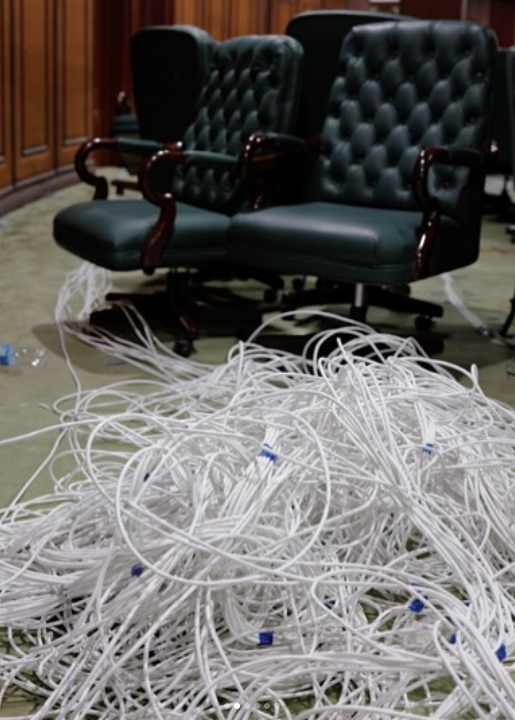
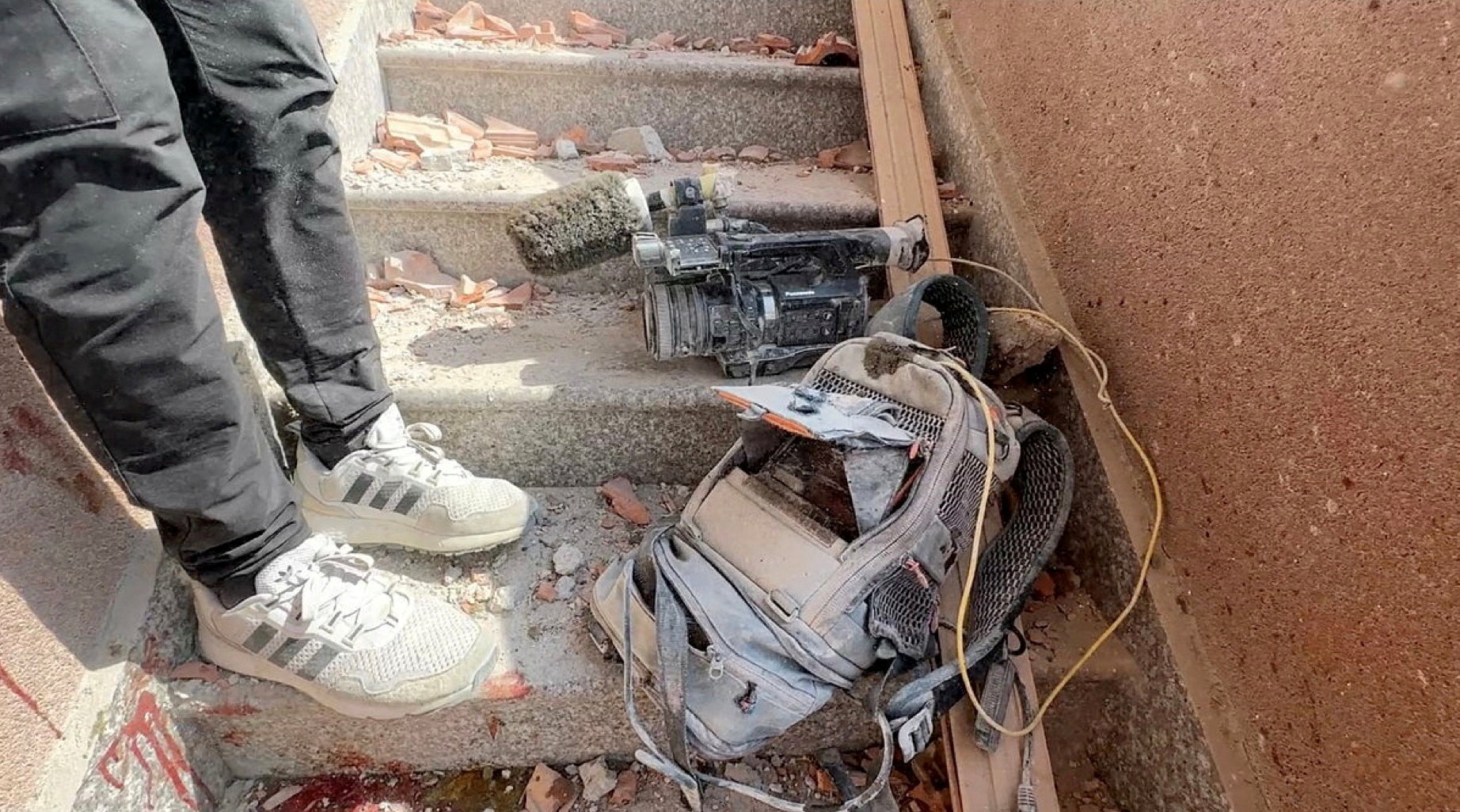
Her images captured security guards directing movement, female journalists working inside the media hub, and tense waiting among reporters. And also, interestingly, the gradual dismantling of the temporary infrastructure, including internet cables being packed away, banners removed, and the space emptied once the negotiations ended. With direct access to decision-makers out of reach, her focus shifted to the process itself, the conditions of reporting, and the environment that sustains it.
That shift, in turn, raises a broader question about how journalism operates under conditions of restricted access and what is expected of a journalist when direct visibility is no longer possible. That debate was also visible in exchanges between Pakistani journalists on X during the Islamabad Talks.
Journalist Shiffa Z. Yousafzai noted that an "overly secretive closed-door approach" inevitably limits journalism because "journalists are not spies, and that distinction matters." She also stressed that "journalism cannot function in an access vacuum".
Another journalist, Kamran Yousaf, pushed back against the idea that access alone defines reporting. He argued that "it’s not the government’s job to help journalists. The govt was doing what it was supposed to do."
To report on Iran-US talks, one needs a far broader understanding of geopolitics, the intricacies within, and several other factors. And this requires a lot of study, homework and experience.
In the same exchange, journalist Faizan Lakhani added that journalism cannot depend solely on official information. Arguing that "a journalist's job is to dig, ask the right questions, and find the story. If we start depending only on what the government chooses to share, then journalism just becomes passing statements." In his view, weak journalism cannot be justified simply by limited access, because "in reality, that’s exactly where real journalism begins", he says.
Building the Narrative From the Outside In
So how should reporting be carried out in closed-door environments? It can be broken down into several approaches:
- Draw a line between what is known and what is not: Separate verified facts from speculation and assumptions.
- Treat silence as data: Pay attention to what's missing. Who isn’t in the room? What isn’t being asked? Whose voices are absent or deliberately missing? Sometimes, the silence could tell you more than what’s said. For example, it could signal boundaries of access, negotiation pressure, or even editorial control.
- Report the media environment: Don’t overlook the conditions of reporting; they are part of the story. This includes how the media space is structured, the facilities, and security arrangements. You can ask questions like, 'Who designed this space? Who controls access and movement?'
- Cross-check within the media space: Journalists should rely on each other, compare notes, identify inconsistencies, and share observations through exchanges between reporters, analysts, and correspondents.
- Build local contacts: Informal conversations with the local staff, security personnel, and venue management can help make sense of what is not publicly disclosed. Even knowing a bit of the local language can help build trust.
- Build context through background knowledge: Historical diplomatic patterns and political context can become a key reporting tool to understand the wider picture and fragmented updates.
- Also, if direct visible access is blocked, as in the Serena Hotel case here, journalists should instead examine the exterior of the venue, why the location was chosen, its history, symbolism, and security logic.
- Be transparent about limitations: Clearly tell audiences what could and could not be verified and how the story was produced. So rather than saying, "I saw it all", instead say, "This is what I was allowed to see, and here is what that limitation likely means."
When official information finally arrives
When official briefings are eventually released, the dynamic shifts again.
"When something official came through, everyone would immediately shift into reporting mode," Hamza Yaqoob noted at the Islamabad Talks.
At that point, access or visibility is no longer the primary challenge. It is differentiation. With all news outlets working from the same statements at the same time, repetition becomes a risk. Headlines converge and language begins to mirror official phrasing. Interpretation, then, becomes central, which requires tracking the time of the updates, identifying shifts in tone, noting what remains unsaid, and linguistically analysing the language of the official wording.
But interpretation is not the only adaptation required in such environments. At the Islamabad Talks, creativity also became part of the reporting process.
During the 21 hours of waiting, I was impressed by all the creative ways people ended up covering the talks as an event," explained Ayesha Mir. "Whether it was about the famous brewed-for-peace coffee, or foreign journalists’ impressions of Pakistan; it was a good reminder of how 700 journalists packed in a room will find ways to produce content one way or another.
In such closed-door environments, "being there" no longer guarantees access in the traditional sense. A locked door, however, is not only a barrier; it can also become a starting point.