As AI accelerates wartime misinformation, fact-checkers across Gaza, Ukraine and Lake Chad are finding that the most effective defence still depends on human networks, local knowledge and shared verification infrastructure.
In October 2023, members of the Arab Fact-checking Network (AFCN) were suddenly faced with the daunting task of verifying hundreds of posts online quickly and doing so without losing their audiences’ trust by ensuring what they published was accurate and in context.
In such an overwhelming moment, AFCN manager Saja Mortada found the most feasible solution was to create a collaborative initiative that would pull resources from within and outside their network.
“When October seventh happened, we noticed a huge spread of fake images and videos about Gaza on social media. At the same time, the fact-checkers in AFCN contacted us, saying they needed more support because they were working 24/7 and misinformation had spread overwhelmingly. Because we expected it to be a huge crisis that would not end in a few days, I created an emergency response,” Saja said in a phone interview.
The first thing on Saja’s emergency plan was to secure funding. She reached out to the International Fact-Checking Network (IFCN) to inform them about their plan to initiate an international collaboration to fact-check information about the Israel-Gaza war.
The collaboration began on October 15, 2023. Organisations in the collaboration supported each other by coordinating to translate Arabic content for non-Arabic fact-checkers, reach sources in Gaza through fact-checkers based in Palestine, and reach wider audiences through cross-publications.
Post-pandemic, the information ecosystem further deteriorated with the launch of ChatGPT in 2022, making it possible to auto-generate false information at scale.
Wars create unusually volatile information environments, sending social media algorithms and purveyors of misinformation into a frenzy because of the overwhelming need for information, whether true or false. It is comparatively similar to the COVID-19 pandemic, when the term ‘infodemic’ “rose from relative obscurity to popular metaphor", according to a study by Oxford University. The World Health Organisation defined an infodemic as “too much information, including false or misleading information in digital and physical environments during a disease outbreak. It causes confusion and risk-taking behaviours that can harm health.” The same could be said of the information ecosystem during conflicts that followed the pandemic.
Post-pandemic, the information ecosystem further deteriorated with the launch of ChatGPT in 2022, making it possible to auto-generate false information at scale. In a series of interviews, surveys and content analyses conducted over a year of researching how fact-checkers verify wartime misinformation and do so both with speed and accuracy to match the rate at which Artificial Intelligence (AI) churns out content, a study published by the Al Jazeera Media Institute here identifies opportunities for human-in-the-loop verification with AI.
Using case studies from the Ukraine-Russia war that began in February 2022, the Israel-Gaza war in October 2023, and finally the Boko Haram insurgency in the Lake Chad region that began in 2014 and continues to make headlines, the research took a comparative approach across the different regions represented – Europe, the Middle East and West Africa. The conflicts analysed were chosen based on access to information and the ability to reach journalists and fact-checkers on the ground.
AI works best when built around those capabilities, not when asked to replace them. The study found that wartime verification is especially effective when AI is built around human verification, not the other way round. It suggests that the most important advantages available to fact-checkers remain human and organisational: local language knowledge, access to sources, contextual judgement, and cross-border collaboration.
The Arab Fact-checking Network (AFCN) brought together 60 fact-checking organisations from 40 countries to collaborate in fact-checking the Israel-Gaza war. Instead of situation rooms, they used a Slack workspace to create a database where they add all published fact-checks on the Israel-Gaza war.
1. The Real Technology Behind Wartime Fact-Checking is Collaboration
Collaborative initiatives have proven to be a productive measure against misinformation during national and global conflicts that tend to cause widespread panic or confusion. This was adopted when twelve organisations formed the Nigerian Fact-Checkers’ Coalition (NFC) to fact-check Nigeria’s 2023 elections. The coalition even set up situation rooms across the country. Similarly, a Kenyan coalition of fact-checking organisations and media stakeholders formed the Fumbua programme, which was established to fact-check the 2022 general elections.
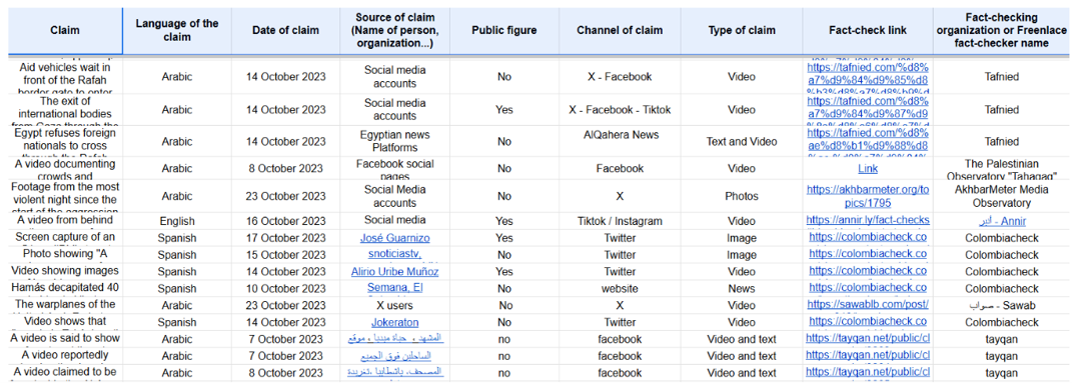
The Arab Fact-checking Network (AFCN) brought together 60 fact-checking organisations from 40 countries to collaborate in fact-checking the Israel-Gaza war. Instead of situation rooms, they used a Slack workspace to create a database where they add all published fact-checks on the Israel-Gaza war. The database uses a structured schema designed for cross-referencing, collaboration, and easy querying.
Some of the core fields captured include the claim made in a post containing misinformation, the platform where the post was published, the date when the post was published, the language used, whether the post was published by an influential individual or news platform, the nature of the post (i.e., image, video or text), if the post was AI-generated, a hyperlink to the published fact-check, and the fact-checking organisation that debunked the claim, among other tags. Such a multilingual, well-tagged repository could train a chatbot that could, for instance, detect misinformation about the Israel-Gaza war by automatically retrieving relevant fact-checks. As of December 2024, AFCN’s database had over 1,000 entries.
Additionally, fact-checkers sometimes worked together to verify complicated cases like deepfakes. According to Saja, AFCN supported 240 journalists in Gaza by providing humanitarian aid, cameras, phones, and eSIMs so they could keep covering what was happening on the ground.
“Because of this collaboration, hundreds of fact-checking reports were published in English, Arabic, French, Italian, Spanish, Japanese, Bulgarian, Persian, Urdu and other languages,” Saja said.
The Digital Technology, Artificial Intelligence and Disinformation Analysis Centre (DAIDAC) found that Facebook accounts promote extremist ideologies in Hausa and Arabic, particularly glorifying activities of Boko Haram and Ansaru terrorist organisations in Nigeria, Chad and Niger.
2. Where AI Still Struggles: Language and Local Context
AI tools often struggle with low-resource languages, names, evolving symbols, local context and culturally specific meanings. Aspects of online communication, like language, underserve over 80% of the non-English-speaking global population. “Algorithms cannot navigate the complexities and subtleties of our [human] communications,” the study shows.
“The internet is multilingual, so is fake news. Fake news is created to gain attention by evoking emotions, which is a playbook that cuts across languages and cultures, albeit there is little research on deception behaviour in other languages besides English," the study quotes a report published on Springer Nature.
The Digital Technology, Artificial Intelligence and Disinformation Analysis Centre (DAIDAC) found that Facebook accounts promote extremist ideologies in Hausa and Arabic, particularly glorifying activities of Boko Haram and Ansaru terrorist organisations in Nigeria, Chad and Niger. Additionally, 75% of respondents in the study’s survey believe there is more misinformation in local languages than from the use of generative AI. 61% of respondents also agreed that more misinformation circulates in local languages than in English in their countries.
On social media, emojis too count as language. Expert linguistic perspectives contextualise emojis’ evolution into a new non-verbal language system that defies geographic boundaries and cultural differences, and the rise of emojis as a universal language that could have both positive and negative impacts on written language.
In reference to the Israel-Gaza war, the watermelon emoji represents Palestine because the colours on a watermelon are the same as on the Palestinian flag. According to Saja, people used such symbols, especially in solidarity with Palestine.
By testing AI tools for biases and inaccuracies, journalists gain insights into their limitations and identify areas for improvement. “For example, a name like Najjar [Arabic] translates to ‘carpenter’ in English. But you can’t literally translate someone’s name. So a lot of the tools that you run information through will translate it and won’t know that it’s a name,” said Mohammed Haddad, the digital interactive team at AJLabs.
3. Fact-Checking Chatbots Are Only as Good as the Database and Networks Behind Them
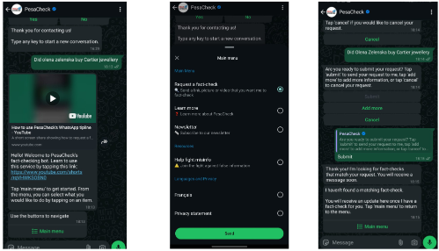
The study found that the most common use of AI in fact-checking organisations is chatbots, where organisations have developed systems that invite the public to share claims they want fact-checked, often via a WhatsApp tip line and sometimes via a web-based chatbot. These systems are linked to a database of previously fact-checked content, and the chatbot can tell users whether a claim is true or false by summarising findings from a fact-checked article and attaching links to fact-checks that debunk the claim.
Fact-checking chatbots were particularly popular during the COVID-19 pandemic, with examples such as ‘BotCovid’ and ‘FactChat’ widely embraced as “functional and reliable” in a previous study. Unlike human fact-checkers, chatbots are available to respond to queries any day, any time. Since 2018, more than 50 fact-checking organisations have partnered with WhatsApp through IFCN to run user-initiated flagging and verification of claims.
The limitation of fact-checking chatbots is not necessarily the chatbot and the conversational interface, but rather the fragmentation behind it. The models are barely connected to a wider database containing fact-checks published by different organisations.
Fact-checking organisations have developed a system that invites the public to share claims they would like fact-checked, often via a WhatsApp tip line, and sometimes via a web-based chatbot. These systems are linked to a database of previously fact-checked content.
4. How AI Is Being Weaponised in Wartime Information Operations
In the Lake Chad region, the Digital Technology, Artificial Intelligence and Disinformation Analysis Centre (DAIDAC) found that blogs run by terrorist groups began publishing posts in fluent, coherent English using ChatGPT, whereas they previously often published posts in broken English. Additionally, the blogs have been churning out regular posts lately. Al Jazeera’s data team, AJLabs, uncovered the use of AI-powered superbots that auto-generated pro-Israeli posts as a counter-narrative in response to pro-Palestine posts. The bots were prompted by keywords like #Gaza, #Genocide, or #Ceasefire.
Rapid advances in natural language processing (NLP), a branch of AI that enables computers to understand and generate human language, meant that bots could do more. From automatically adding friends on Facebook to generating entire social media profiles with human faces, as well as replying and commenting on posts in a conversational way while being assigned personality types.
A study by Clemson University revealed the use of generative AI to fabricate a news website named DCWeekly. A website that appeared professional, even including profiles of contributing journalists, but was actually a pro-Russia narrative-laundering tool to peddle anti-Ukraine and anti-Western narratives. The faces of the listed journalists were either lifted from stock art or impersonated legitimate journalists.
As of December 2024, NewsGuard identified more than 1,000 unreliable AI-generated news and information websites spanning 16 languages. Only about a third (32%) of the fake photos NewsGuard found included a fact-check label.
Al Jazeera’s data team, AJLabs, uncovered the use of AI-powered superbots that auto-generated pro-Israeli posts as a counter-narrative in response to pro-Palestine posts. The bots would be prompted by keywords like #Gaza, #Genocide or #Ceasefire…. automatically adding friends on Facebook, generating entire social media profiles with human faces, as well as replying and commenting on posts in a conversational way.
Context-blind AI tools show that accurate content moderation and fact-checking during war require local, human expertise. AI systems are often trained on rigid, Western-centric datasets that often fail to decode such dynamics.
Cross-collaborative initiatives and developing a multi-institutional large language model to train chatbots in both English and non-English languages can complement a fact-checker’s process in achieving speed and accuracy during emergencies.
In wartime verification, AI’s value depends less on autonomous detection than on human networks, local knowledge, and shared database infrastructure.