
An analysis of 180 articles from the BBC, The Guardian, The New York Times and CNN found that coverage of hunger in Gaza frequently linked the crisis to political decisions and identified responsibility rather than treating it only as a humanitarian emergency. Tracking the same outlets through early August 2026 also shows that this coverage came in sharp waves, with periods of intense reporting separated by months of limited attention even as severe food insecurity persisted.
Coverage of hunger in Gaza has varied considerably since late 2023. Across the BBC, The Guardian, The New York Times and CNN, 81 articles appeared in March 2024. By July 2024, the number had fallen to two, even as food insecurity in Gaza remained severe. Reporting increased again the following year, reaching 50 articles in May 2025 and 68 in July, before declining again later that year.
Instead of suggesting a simple decline in media interest, these changes raise a broader question about how news organisations cover a humanitarian crisis that remains serious for a long time: what makes an ongoing condition become news again?
To examine this, I analysed 180 articles published by the four outlets between December 2023 and May 2024, looking at how they framed the food crisis, attributed responsibility and used sources. I then extended the analysis through early August 2026 with a comparable count of news coverage to examine how attention changed after the original study period.
Responsibility Was Already Visible
Hunger in Gaza was rarely presented as a purely humanitarian crisis without linking it to political causes, which is a clear strength in the reporting. Reporting starvation without explaining the policies and restrictions contributing to it would show readers its consequences without adequately explaining its causes. In 78.9% of the articles, the food crisis was specifically connected to the blockade, restrictions on aid, border access or other forms of obstruction. This political context appeared in all four outlets, although at different rates: 83% of The Guardian’s articles and 82.9% of the BBC’s included it, compared with 77.4% of The New York Times’ articles and 71.8% of CNN’s.
A Guardian visual investigation published in March 2024 provided a particularly detailed example of this, tracing the food shortage through Israel’s control of land routes, its inspection and rejection of shipments, and the limitations of delivering aid by air or sea. It described the crisis as “artificially created” and explained how political and military control over the routes into Gaza restricted the amount of food that could reach civilians. Not every article provided this degree of explanation, but political context appeared in a clear majority of the coverage at each outlet.
Responsibility was similarly explicit, as Israel was directly identified as responsible for the conditions producing hunger in 86.1% of the articles, compared with 12.8% that left responsibility vague or unspecified and just over 1% that explicitly attributed responsibility to Hamas or Palestinian authorities.
The more significant findings lie in the gap between attributing responsibility and characterising that responsibility. While the coverage overwhelmingly identified political decisions and Israeli actions as central to the production of hunger, it was less willing to describe that action in the context of war crimes. Many UN reports and NGOs had already pointed to war crimes, collective punishment, genocide, the deliberate blockade of aid entry, and weaponizing starvation. However, the clearest evidence of the gap appears when responsibility and criminal framing are considered together. Of the 155 articles that directly identified Israel as responsible for conditions producing hunger, 58.1% did not use criminal or legal language. When the comparison is narrowed to the 135 articles that both identified Israel and connected hunger to blockade, aid restrictions or political obstruction, 61.5% did not refer to war crimes, collective punishment, genocide or starvation as a weapon.
A New York Times explainer published in April 2024 made this distinction clear. It described the crisis as “entirely human-made,” said that food shortages had been created by Israel’s blockade and military operations, and reported accusations that Israel was slowing aid “to punish Gazans.” Yet it did not address whether these actions could constitute collective punishment, a war crime, or the use of starvation as a weapon. It is in this way that much of the reporting identified who was responsible and described the mechanism through which starvation was produced, but stopped short of confronting the legal and political implications of that evidence.
One Crisis, Different Kinds of Story
Identifying political responsibility did not prevent these outlets from also presenting hunger as a humanitarian story, with more than 71% focusing substantially on civilian suffering and half giving significant attention to aid delivery. These approaches frequently overlapped, as the same article could describe the effects of hunger, explain the political restrictions contributing to it and follow efforts to deliver food.
There were differences, however, in which parts of the crisis received the most attention. Within this sample, aid operations appeared much more frequently in the BBC and The Guardian, where 71.6% of articles included a substantial aid-logistics frame, compared with 29.3% across The New York Times and CNN. This difference was specific to aid operations rather than humanitarian attention generally, since the two groups devoted almost identical levels of coverage to civilian suffering. The British outlets were therefore more than twice as likely to give sustained attention to aid delivery and the restrictions affecting humanitarian access. This coverage retained its political context, with 87.3% of their aid-focused articles also linking hunger to blockade, restrictions or obstruction. For example, a BBC analysis asking whether Israel was meeting its promise to allow more aid into Gaza found that it was not doing so. Although Israel had announced new crossings and reported an increase in deliveries, truck numbers soon fell again, the UN disputed the Israeli figures, and alternatives by sea and air remained too limited to meet the need.
UN agencies and international humanitarian organisations were also the most prominent source in 47.2% of all articles, more than any other source category, placing the tasks of humanitarian institutions in a central position within the coverage.
The Famine Story Came in Waves
After the March 2024 peak of 81 articles, coverage fell to 34 articles in April, 26 in May and 15 in June, before almost disappearing from the news agenda with only two qualifying articles in July, one in August and one in September.
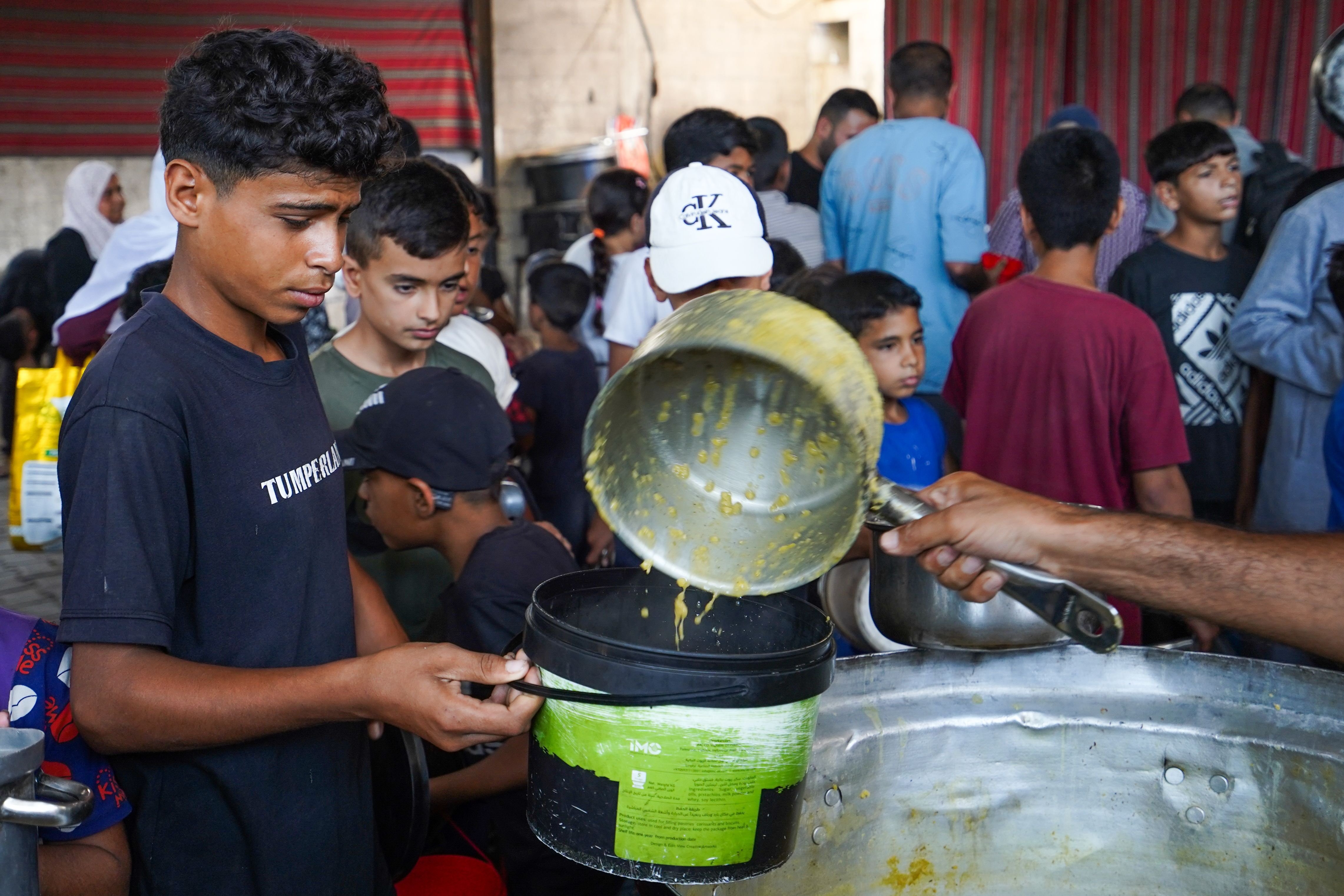
Yet food security had not improved enough to account for such a sharp fall in coverage. During the same months in which reporting fell to its lowest levels, an IPC assessment published on June 25 found that 95% of Gaza’s population had faced crisis-level food insecurity or worse between May 1 and June 15 and projected that the figure would reach 96% between mid-June and the end of September, meaning that extremely severe food insecurity persisted.
Coverage returned on a large scale in 2025, rising to 50 articles in May, 21 in June and 68 in July, followed by another 30 in August. The return coincided with a further deterioration in food security as well as several new developments, including intensified restrictions on aid, the introduction of a new US and Israeli-backed distribution system in late May, new warnings from humanitarian organisations and, in August, the IPC’s formal classification of famine in Gaza Governorate, which Israel disputed.
The deterioration itself was measurable. In May 2025, the IPC reported that 93% of the population was experiencing crisis-level food insecurity or worse and described conditions as having deteriorated significantly from its previous assessment, projecting that the entire population would fall into those categories during the following months. A later IPC assessment covering July and the first half of August also found that the entire population it was able to analyse was “experiencing crisis-level food insecurity or worse”, indicating that there were more than half a million people in the most severe category.
During the same months in which reporting fell to its lowest levels, an IPC assessment published on June 25 found that 95% of Gaza’s population had faced crisis-level food insecurity or worse between May 1 and June 15 and projected that the figure would reach 96% between mid-June and the end of September, meaning that extremely severe food insecurity persisted
The return was not equally large across the four British and American media outlets. Between May and July 2025, the BBC and The Guardian together published most of the 139 articles (106 articles) identified in the count, compared with 33 from The New York Times and CNN.
This difference was also notable in the earlier framing results, since the two British outlets had also devoted substantially more of their original coverage to aid operations than the two US outlets.
With data analysis of only two outlets from each country, these findings cannot be considered a fully representative analysis of these countries’ media coverage trend. However, what we can conclude from this study sample is that the British outlets gave aid operations more attention and returned to the food crisis coverage much more frequently during 2025’s Gaza famine crisis.
The timing suggests that the 2025 resurgence of coverage developed around a succession of new events rather than the August famine classification alone. Coverage had already risen sharply in May as the aid blockade continued and the new US and Israeli-backed distribution system began operating, before reaching its second-highest monthly total in July amid further deterioration and renewed attention to starvation and aid access. The formal famine classification in August was, therefore, just another major development in an already renewed period of coverage rather than the event that initiated it.
With data analysis of only two outlets from each country, these findings cannot be considered a fully representative analysis of these countries’ media coverage trend. However, what we can conclude from this study sample is that the British outlets gave aid operations more attention and returned to the food crisis coverage much more frequently during 2025’s Gaza famine crisis.
When Does an Ongoing Crisis Become New Again?
The uneven relationship between the severity of the food crisis and the amount of coverage it received makes more sense when considered alongside the way news organisations handle continuing events. Newsrooms operate with limited attention and must continually decide which developments warrant another story, which creates a particular problem for crises that remain severe for months or years without necessarily producing a distinct event every day. New assessments, changes in aid policy, border restrictions, institutional warnings and official classifications can provide the development around which continuing conditions become reportable again.
The Gaza coverage follows this pattern as severe food insecurity persisted during the low-attention months of 2024 while the substantial deterioration in 2025 coincided with new aid arrangements, humanitarian warnings and assessments as well as a large return in reporting. The prominent role of humanitarian institutions in the original sample also fits this pattern, since the same organisations that journalists relied on to describe the crisis produced food-security assessments, aid statistics and formal warnings that provided new information about changing conditions. This does not establish that these developments caused the peaks in coverage, but it shows that severity alone did not correspond consistently with the amount of attention the crisis received.
Recognising a continuing crisis and sustaining attention to it are not quite the same journalistic process, since the four outlets often identified political causes and responsible actors clearly when they reported on hunger in Gaza, yet the volume of that reporting still rose and fell sharply as the crisis continued. The pattern points to a broader problem for journalism: a crisis can remain severe without continually producing developments that are treated as new, creating a gap between how long the crisis lasts and how long it can remain continuously newsworthy.