Journalists should treat Israeli sources with particular scrutiny because anonymous briefings, military censorship, strategic leaks and recycled analysis can blur the line between verified information, speculation and propaganda, with real consequences for audiences on the ground.
For more than 15 months of genocide, Gazans have continued to follow news of the deal being implemented between Israel and the Palestinian resistance factions in the Gaza Strip, as well as the previous attempts to reach one. They saw it as a lifeline from a war that had killed more than 46,000 people, wounded more than 110,000, and left more than 11,000 missing.
As negotiation rounds began, international calls for the need to conclude the deal became a key driver for bringing relief to those affected, while US officials increasingly promised that its completion was imminent. Yet the facts on the ground suggested otherwise. The Palestinian citizen therefore remained hostage to statements attributed to informed and private sources, and to senior officials presented as anonymous sources, increasing the ambiguity surrounding the information and casting doubt on its credibility.
The Palestinian citizen remained hostage to statements attributed to informed and private sources, and to senior officials presented as anonymous sources, increasing the ambiguity surrounding the information and casting doubt on its credibility.
A review of a sample of what was published in this context, by examining some of the breaking news, reports and analyses carried by Palestinian and Arab media outlets since the beginning of efforts to reach a ceasefire, reveals the extent of the contradiction in media content citing Israeli sources, ranging from reports heralding the imminent completion of a deal to reports expressing shock that the process had reached a dead end.
Thus, on 24 February last year, one news website published the headline: “After Paris talks... Israeli media reveal possible Gaza truce before Ramadan”. The report, citing Israeli media, stated that there was a strong possibility that a deal to exchange captives in Gaza for Palestinian prisoners would be reached before the beginning of Ramadan. Likewise, on 24 November of the previous year, one website published a report stating: “Israeli official: Gaza deal is close... and Hamas ‘ready to compromise’.”
The report, citing a senior Israeli security official and relying on the Israeli newspaper The Jerusalem Post, said that a hostage deal in Gaza was “closer than ever”, and that Hamas was prepared to abandon its demand for a complete end to the war, something that had not been conveyed by any Palestinian source responsible for the negotiations since the rounds began.
In December of the previous year, a news agency published a report headlined: “Israeli newspaper: Gaza prisoner exchange deal may be reached within two weeks”. The report, relying on Israel Hayom, quoted unnamed Israeli officials as saying that a prisoner exchange deal in Gaza could be reached within one to two weeks.
In February of last year, a digital news platform reported, citing Israel’s Channel 12, that an agreement between Israel and Hamas was close. The report quoted the channel as saying that a US source had stated that the final touches were being put on an agreement between Israel and Hamas.
This sample of news reports, followed with anticipation by Palestinians and Gazans in particular, quickly turned into disappointment over the possibility of ending their tragic circumstances, and media outlets began to resemble an illusion in their eyes. Despite growing awareness among Palestinian media of the importance of carefully selecting news from Israeli sources when translating and relaying material from Hebrew-language media, some journalists still fall into the trap of adopting everything issued by those sources as a scoop or as a means of increasing audience engagement.
Understanding the Media Context
The anticipation among Palestinian journalists for news of the deal in Hebrew-language media is natural, according to journalist and Israeli affairs specialist Ahmad Fayyad, who told Journalism Magazine: “Everyone is searching for information and trying to understand its nature, especially among Israeli officials, who adopted a position marked by considerable ambiguity and lack of clarity.”
Fayyad believes that “despite this, there was control over the Israeli position in terms of not disclosing many of the developments and details of the war, indeed all of its details, including the issue of recovering the hostages. The deal was one of the war’s objectives, and therefore these details were kept under blackout, leaving the door partly open to speculation.”
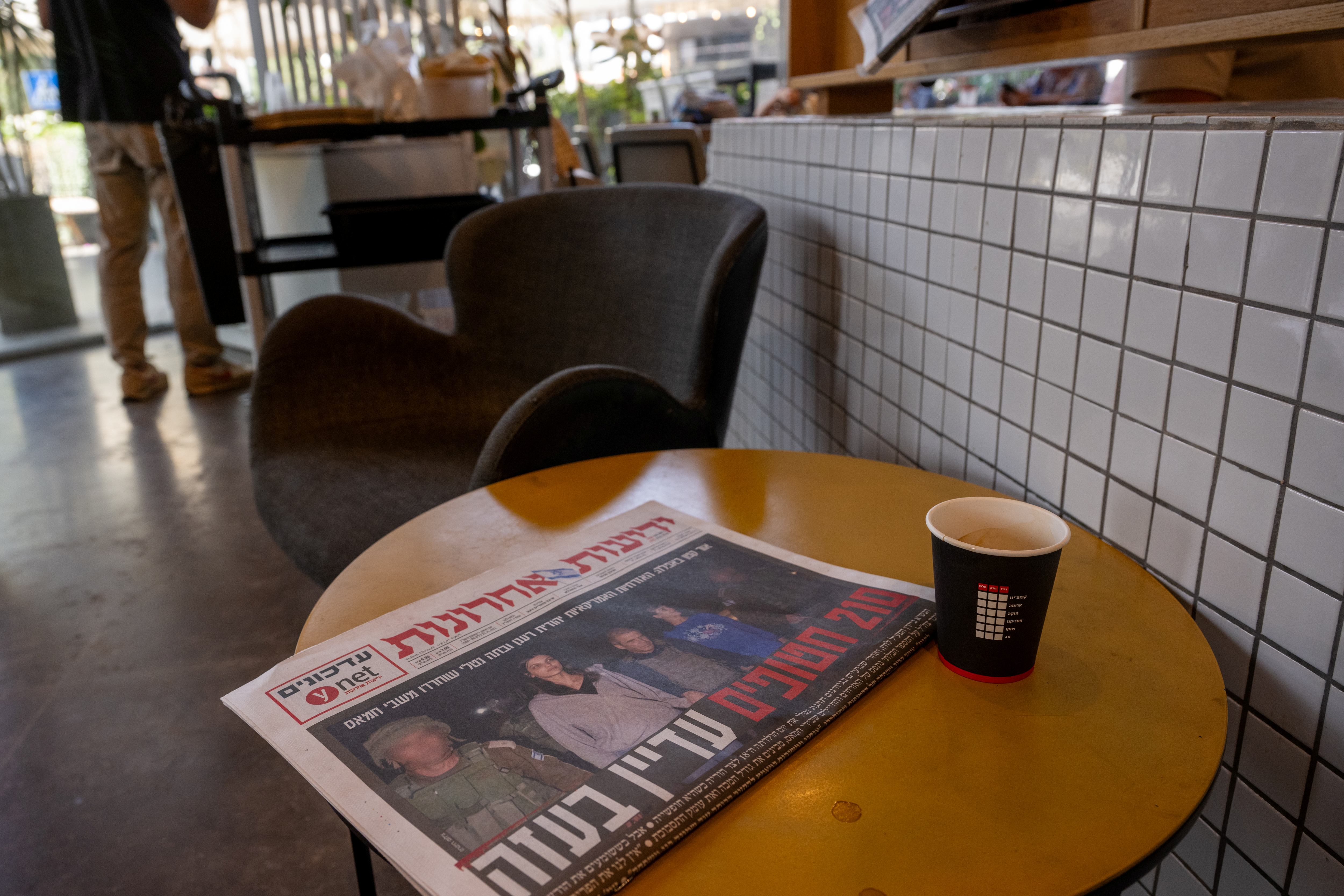
Accordingly, the Israeli government did not disclose this information in the same way as Arab sources, on the grounds that it was subject to military censorship, in addition to the “publication ban” clause, one of the features of Israel’s lessons from previous campaigns and wars. This time, however, it was implemented to the letter. Whatever emerged through the media did so in accordance with Israeli wishes and for predetermined objectives.
Despite the scarcity of information, media monitoring shows what can be described as a “torrent” of conflicting information, rumours and leaks, which some Palestinian media outlets fell victim to promoting.
The danger, according to writer Iyad al-Qarra in comments to Journalism Magazine, lies in exhausting Palestinian citizens with misleading news that kept them in a state of tension throughout the war. News of a possible truce would spread in the morning, only to disappear by evening.
Fayyad, meanwhile, points to another problem: most of the news and leaks concerning the deal that were circulated by Israeli media outlets and journalists “were originally drawn from Arab sources. Israeli journalists would then seek to determine the nature and credibility of this news from official sources, after which the same reports would return as analysis rather than information”.
Most of the news and leaks concerning the deal that were circulated by Israeli media outlets were originally drawn from Arab sources. Israeli journalists would then seek to determine the nature and credibility of this news from official sources, after which the same reports would return as analysis rather than information.
Distorted Information
Some information and statements relating to the deal were also not spared distortion, as a result of translators adding their own analysis and interpretation, as well as selecting particular readings of certain positions and translating them.
According to Fayyad, some Arab media outlets were observed focusing on translating what Israeli writers, researchers at research centres, or retired reserve officers said on televised talk shows, after which these statements were taken as information and presented to Arab and Palestinian audiences, even though these discussions themselves often originated in Arab media.
Iyad al-Qarra agrees with this view, saying: “The problem is both old and new. Despite improvements in media performance in this regard, professional violations on this issue are still being committed.”
As a reflection of the above, some cases revealed an “eagerness” among translators and those relaying material to follow media content concerning the deal without distinguishing between news and propaganda. At times, information contained in an article, or the opinion of a researcher, military correspondent or strategic expert in a particular media outlet, would be taken out of context and treated as a journalistic scoop.
The danger of this kind of translation, when it is not governed by professional standards, according to al-Qarra, is that it often created confusion among displaced people and prompted some to return to their homes, only to discover later that those places had become death traps.
In some cases, there was an “eagerness” among translators and those relaying material to follow media content concerning the deal without distinguishing between news and propaganda. At times, information contained in an article, or the opinion of a researcher, military correspondent or strategic expert in a particular media outlet, would be taken out of context and treated as a journalistic scoop.
Anticipated Solutions
In the face of this torrent of misleading news, whose spread has been amplified by social media platforms, media professionals are required to exercise greater control over translation and relay practices in a way that serves the interests of Palestinian society and establishes the principle of social responsibility in media, particularly in preserving the interests of society and, foremost among them, the emotional state of displaced people awaiting news of a ceasefire. According to al-Qarra, this cannot be achieved unless the Palestinian journalist adopts a clear national position regarding what is published about the deal and its developments, even after its completion.
For this reason, the reality of the situation confirms the need to draw lessons from the media experience of the war, as Fayyad says: “Just as committees are formed to examine the performance and conduct of Israeli media, draw lessons and conclusions from failures, and correct the course in the future.”
Those relaying such news are also required to scrutinise what they translate for the public, place it in its original context, present it in its true form, and clarify the nature of the translated text, distinguishing between what should be classified as information and what should be classified as opinion.
Palestinian universities should also give greater attention to graduating media professionals who are proficient in foreign languages in addition to mastering Hebrew, because the Palestinian narrative is clear and just and does not require much effort to communicate effectively if its media discourse is properly formulated.
Based on the above, and despite the difficulty of fully controlling the media environment, the principal standards governing professional and responsible media practice, together with self-regulation, remain the decisive factors for journalists in filtering everything issued by Israeli media, subjecting it to scrutiny, verification and disciplined translation in order to preserve the profession, public morale and people’s lives as well.
This article was originally published in Arabic on 20 Jan 2025