Al Jazeera Journalism Review

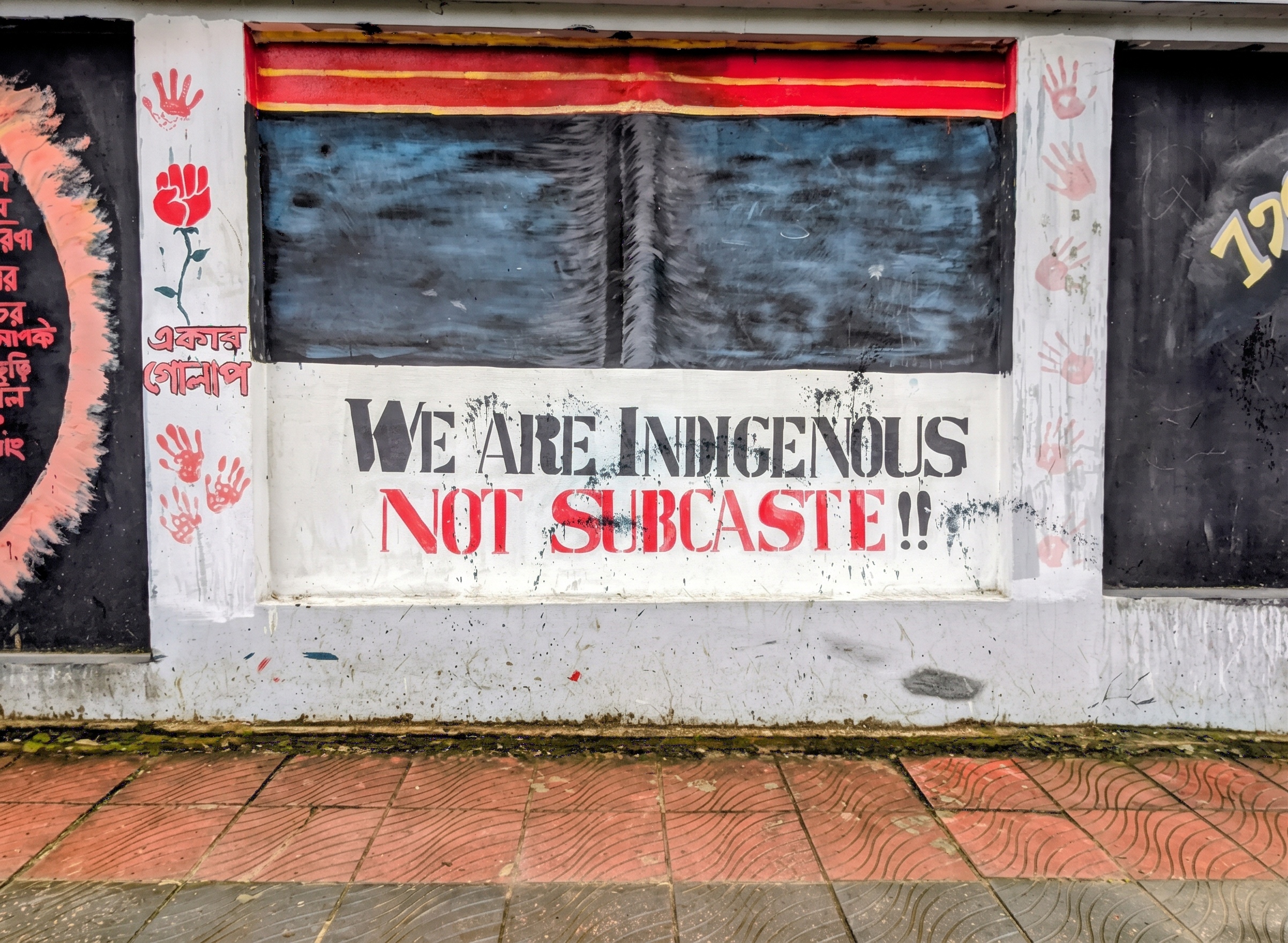
Graffiti painted by indigenous artists calls for constitutional rights for Bangladesh’s Indigenous people. (Photo: Denim Chakma, Rangamati, Bangladesh-September 9, 2026
Graffiti painted by indigenous artists calls for constitutional rights for Bangladesh’s Indigenous people. (Photo: Denim Chakma, Rangamati, Bangladesh-September 9, 2026)

Bangladesh: Crackdown on Reporting on Indigenous Communities

In newsrooms across Bangladesh, the word 'Indigenous' has become too dangerous to put in print. Editors quietly strike it from the copy, wary that a single mention could invite the wrath of the state.


Through a campaign by the country’s military intelligence agency, the Directorate General of Forces Intelligence (DGFI), and the Ministry of Information, mainstream journalism has effectively banished the term "Indigenous". Earlier in August, two cabinet ministers declared that Bangladesh has no indigenous population at all. Therefore, they argued, the word had no place in the national vocabulary. 

This prohibition is not a mere update to a government style guide. To indigenous journalists, it is a calculated effort to rewrite history, erase distinct cultural identities, strip indigenous communities of long-recognised rights, and tighten the state’s grip on the press. ‘‘It feels like an attempt to strip away our identity and rights,’’ said Rikors Chakma, an Indigenous journalist working in the Chittagong Hill Tracts. 

Indigenous reporting has been driven to the brink of collapse by mounting pressure, according to him. Especially replacing Adivasi with terms such as "small ethnic groups" is aimed at omitting personal identity from reports, which creates frustration and a psychological barrier for journalists. 

The consequences of defiance are swift. "Claiming there are no Indigenous people implies that their problems do not exist either," said Buddha Jyoti Chakma, an Indigenous journalist working in Chittagong Hill Tracts for more than two decades. He noted that news coverage of Indigenous issues is being actively suppressed.  

Buddha Jyoti views the recent crackdown as a threat to Bangladesh’s entire Indigenous population. "If a minister holding a responsible state position purposefully claims that there are no Indigenous peoples in the country," he said, "it is dangerous for Indigenous communities."


Why Reporting on Indigenous Issues Matters 

Bangladesh’s Indigenous communities in the Chittagong Hill Tracts are living under militarisation, enduring armed conflict, and facing extrajudicial killings. Journalists need to investigate these human rights violations. They can expose systemic abuses, hold authorities accountable, and amplify the silenced voices of marginalised communities. Ultimately, documenting these realities is a fundamental obligation of a free press.  

Reporting on incidents such as the seizure of Indigenous forests and land, the rape of Indigenous women, and the torture and killing of Indigenous youths in the custody of law enforcement remains a major challenge for Bangladeshi journalists. The moment they arrive at the scene, they are confronted by the administration on site. Because the Chittagong Hill Tracts are dotted with numerous military checkpoints, journalists face constant interrogation as they pass through them. After a story is published, media workers are often summoned to army camps, where editors are pressured to take the story down. 

Dipayan Khisha, former editor of IP News BD, said Indigenous journalists and news outlets in Bangladesh have long operated under the threat of censorship.  

"The experience of running an Indigenous online news portal was not a pleasant one under the Hasina government," he told Al Jazeera Journalism Review. "Whenever we published news about human rights violations by law enforcement, it would be blocked almost immediately."

As editor of IP News, Khisha said he and his colleagues were forced to repeatedly change the site’s domain name to stay online. "We kept the core name, IP News, intact," he said, "but we had to keep switching domains just to keep the portal running."

Sydia Gulrukh worked as a journalist for more than a decade. In an interview, she said, "In the Chittagong Hill Tracts, the civil and military administration has been waging a decades-long war on truth, controlling, directly or indirectly, the flow of information.’’ When the military issues a statement following a security operation or a rights violation, it arrives less as information than as instruction. The media is expected to relay the official narrative. Those who pursue independent leads do so at their peril. 

Sydia added, "Journalists who question that account or pursue independent leads, whether reporting from the Hill Tracts or from Dhaka, can face consequences."

The latest escalation came on August 11, when Home Minister Salahuddin Ahmed told a roundtable in Dhaka that no separate indigenous group exists in the country. The information minister, Zahir Uddin Swapan, went further, dismissing the term ‘‘indigenous’’ as irrelevant to Bangladesh altogether. 

This linguistic policing spans administrations. In 2022, under the ousted government of Sheikh Hasina, the information ministry circulated a directive ordering television stations to drop the word "Indigenous". The order, signed by a deputy secretary in the information ministry, cited guidance from the DGFI. As early as 2015, military intelligence officers were pressured by major companies to pull advertising from two prominent newspapers. Just after, these newspapers described men killed by the army in the Chittagong Hill Tracts as indigenous rather than as "insurgents".

In this context, repeated statements from senior officials risk creating a climate of fear, self-censorship, intimidation, surveillance, or reprisals against journalists documenting legitimate human rights concerns. Protecting press freedom requires ensuring that journalists can report independently and accurately on Indigenous issues without political interference or intimidation. 


Press Freedom Continues to Shrink in Bangladesh 

A crackdown on the news media coincides with the ongoing struggle of Indigenous populations for recognition, land rights, and demilitarisation of the Chittagong Hill Tracts. Systemic intimidation has contributed to Bangladesh’s low ranking, 152nd, on the World Press Freedom Index.  

"Bangladesh has had three governments in under two years: Hasina’s Awami League, the Yunus-led interim administration, and now Tarique Rahman’s BNP government since February 2026, and through each transition, journalists have been detained, prosecuted and surveilled," Kunal Majumdar says. 

The Asia-Pacific Program Coordinator of CPJ noted that although Tareq Rahman’s government campaigned on a pledge to safeguard press freedom, meaningful progress remains limited.  

Bangladesh has not ratified the International Labour Organization’s (ILO) Convention 169. Yet it remains bound by an earlier 1957 ILO convention on indigenous and tribal populations, as well as by the broader human rights covenants it has ratified. The fresh remarks from one of the BNP-led government’s top ministers drew swift condemnation from advocacy groups. In a joint statement, the International Work Group for Indigenous Affairs and the International Chittagong Hill Tracts Commission said they viewed the ministers’ comments with grave concern and rejected the premise that Bangladeshi citizenship and indigenous identity are mutually exclusive.   

"When senior government officials publicly declare that the term 'Indigenous' is irrelevant or deny the existence of Indigenous Peoples, it can inadvertently discourage journalists and media outlets from using internationally recognised terminology or covering Indigenous rights issues accurately." Kathrin Wessendorf, executive director at IWGIA, told Al Jazeera Journalism Review.  

Kathrin stressed that the ministers’ remarks do not in themselves constitute a censorship measure, but they raise legitimate concerns about the broader environment for press freedom and civic space.  

Responsible reporting depends on journalists being able to describe communities according to their own identities and document issues such as land rights, violence, discrimination, and implementation of the Chittagong Hill Tracts Accord without political pressure. If state agencies continue to dictate how journalists cover marginalised Indigenous communities, the interference will not only perpetuate systemic injustice but also further suffocate press freedom in Bangladesh.  


The views expressed in this article are those of the author and do not necessarily reflect the views of the Al Jazeera Journalism Review 

Related Articles

Bangladesh’s Digital Security Act is criminalising journalism

Bangladesh has been quietly strengthening its laws curtailing freedom of expression - with dangerous results

Rokeya
Rokeya Lita Published on: 18 Apr, 2022
Public Hostility Toward Legacy Media in Bangladesh

The December 2025 arson attacks on Prothom Alo and The Daily Star marked a turning point for journalism in Bangladesh. As public anger replaces state control as the primary threat, reporters are reassessing personal safety, editorial judgement, and professional credibility in a political transition where journalism itself is increasingly treated as an enemy.

Arsalan Bukhari, an independent journalist based in India
Arsalan Bukhari Published on: 4 Feb, 2026
Bangladesh: Why Were Foreign Correspondents Absent?

In the recent political upheaval in Bangladesh, many foreign journalists were reporting from nearby regions like New Delhi. In this absence, local journalists played an important role in conveying firsthand accounts of the events that unfolded to the world.

Anam Hussain
Anam Hussain Published on: 26 Aug, 2024

More Articles

Why should journalists be cautious with Israeli sources?

Journalists should treat Israeli sources with particular scrutiny because anonymous briefings, military censorship, strategic leaks and recycled analysis can blur the line between verified information, speculation and propaganda, with real consequences for audiences on the ground.

Ahmad Al-Agha
Ahmad Al-Agha Published on: 7 Oct, 2026
The economics of truth: How Lack of Funding is Compromising Quality Journalism in Africa

Reporting and newsgathering cost money; they require time, patience and experienced personnel. However, globally limited funding is leading to a generally compromised journalism output.

Derick Matsengarwodzi
Derick Matsengarwodzi Published on: 30 Aug, 2026
Who Decides the News? Inside India's Algorithm-Driven Newsrooms 

Editors once decided which stories mattered based on evidence, public interest and ethics. Today, recommendation algorithms and engagement metrics increasingly shape editorial decisions, prioritising what keeps audiences scrolling.

Seerat-Un-Nisa Published on: 11 Aug, 2026
Asif Hamidi: Journalism Must Not Hide Crimes Behind 'Balance'

Asef Hamidi, Managing Director of Al Jazeera Arabic Channel, says the Gaza coverage was a professional duty, not activism, and that true objectivity means reporting crimes clearly rather than hiding behind false “balance”.

Mohammed Ahddad
Ahdad Mohamed Published on: 24 Jul, 2026
How Journalists Report on Insurgency in Nigeria Without Access or Safety

Journalists covering Nigerian conflicts increasingly use remote reporting methods that rely on local fixers and open-source data, forcing a dependence on digital tools that limits direct physical context. Reporters share these difficult realities, exposing how safety risks change the way conflict is documented and asking how the media can keep news accurate when journalists cannot reach the ground.

Nigerian freelance Journalist John Chukwu
John Chukwu Published on: 20 Jun, 2026
Anthropomorphising AI in War: How Click-Bait Headlines Humanise Algorithms and Dehumanise Civilians

North American mainstream journalists covering US and Israel-led algorithmic warfare frequently use anthropomorphic language that humanises technologies like machine learning, forcing a reliance on tech-elite jargon that sanitises the immense human cost and removes accountability from the state actors and weapon developers.

Sarah Samuel-Ayyash
Sarah Samuel-Ayyash Published on: 11 Jun, 2026
Reporting on People Who Cannot Leave

The arrest of an Afghan female athlete after appearing in a Dutch documentary highlights the dangers of reporting under authoritarian rule. It underscores a growing dilemma in journalism regarding how to amplify the voices of vulnerable people without accidentally turning them into targets for the regime.

Sayed Jalal
Sayed Jalal Shajjan Published on: 4 Jun, 2026
The Vanishing Foreign Desk: What U.S. Media Cuts Mean for South Asia

Recent restructuring at Voice of America and The Washington Post marks a significant withdrawal from global journalism, particularly affecting coverage in South Asia. As these major institutions cut staff and close foreign bureaus, the loss of experienced expertise threatens the visibility of critical regional issues like human rights and climate change. This shift forces a move toward narrative independence for local media, yet leaves a dangerous gap in the global conversation that smaller newsrooms struggle to fill.

Sajid Raina
Tauseef Ahmad, Sajid Raina Published on: 8 May, 2026
Why Anonymous Sources Are Fading from Indian Journalism

A generation of reporters-built careers on confidential sources, many now write without them.

Kamran Yousuf
Kamran Yousuf Published on: 19 Apr, 2026
AI, Copyright Reform and the Fragile Reinvention of Indian Journalism

India’s proposed AI copyright framework risks turning independent journalism into a pooled data resource, undermining the subscription-based models that sustain it. At a moment of political and economic fragility, the struggle over AI licensing is ultimately a struggle over who controls, values, and profits from journalistic work.

Arsalan Bukhari, an independent journalist based in India
Arsalan Bukhari Published on: 31 Mar, 2026
How AI Can Clean Messy Data; and Where It Can't

Normalising inconsistent, messy, or incomplete data is tedious and time-consuming, but essential. AI can handle grunt work, but editorial decisions remain with the journalist.

KA
Konstantinos Antonopoulos Published on: 21 Mar, 2026
Why Editorial Planning is Key in Today's Relentless News Cycle

In the past, having a detailed editorial plan was something extra that only some newsrooms did, but today it is a necessary part of surviving the non-stop news cycle. As newsrooms move away from old paper deadlines and into a digital world run by social media and search engines, having a clear plan is what keeps a team organised instead of stressed.

Faras Ghani Published on: 12 Mar, 2026
Investigating the Assassination of My Own Father

As a journalist, reporting on the murder of my father meant answering questions about my own position as an objective observer.

Diana López Zuleta
Diana López Zuleta Published on: 16 Jan, 2026
Propaganda: Between Professional Conscience and Imposed Agendas

When media institutions first envisioned editorial charters and professional codes of conduct, their primary goal was to safeguard freedom of expression. However, experience has shown that these frameworks have often morphed into a "vast prison", one that strips journalists of their ability to confront authority in all its forms. In this way, Big Brother dons velvet gloves to seize what little space remains for the practice of true journalism.

فرح راضي الدرعاوي Farah Radi Al-Daraawi
Farah Radi Al-Daraawi Published on: 17 Oct, 2025
Narrative Without Debate: The Telegraph’s Comment Ban on Gaza Coverage

What does it mean for readers when their voices are deliberately cut off? This content analysis of The Telegraph, a UK-based conservative newspaper known for its pro-establishment stance and alignment with right-leaning narratives, shows it systematically disabled Instagram comments on Israel-Gaza posts, blocking dissent and shaping a one-sided, pro-Israel narrative.

Mohammed Ramees
Mohammed Ramees Published on: 9 Oct, 2025
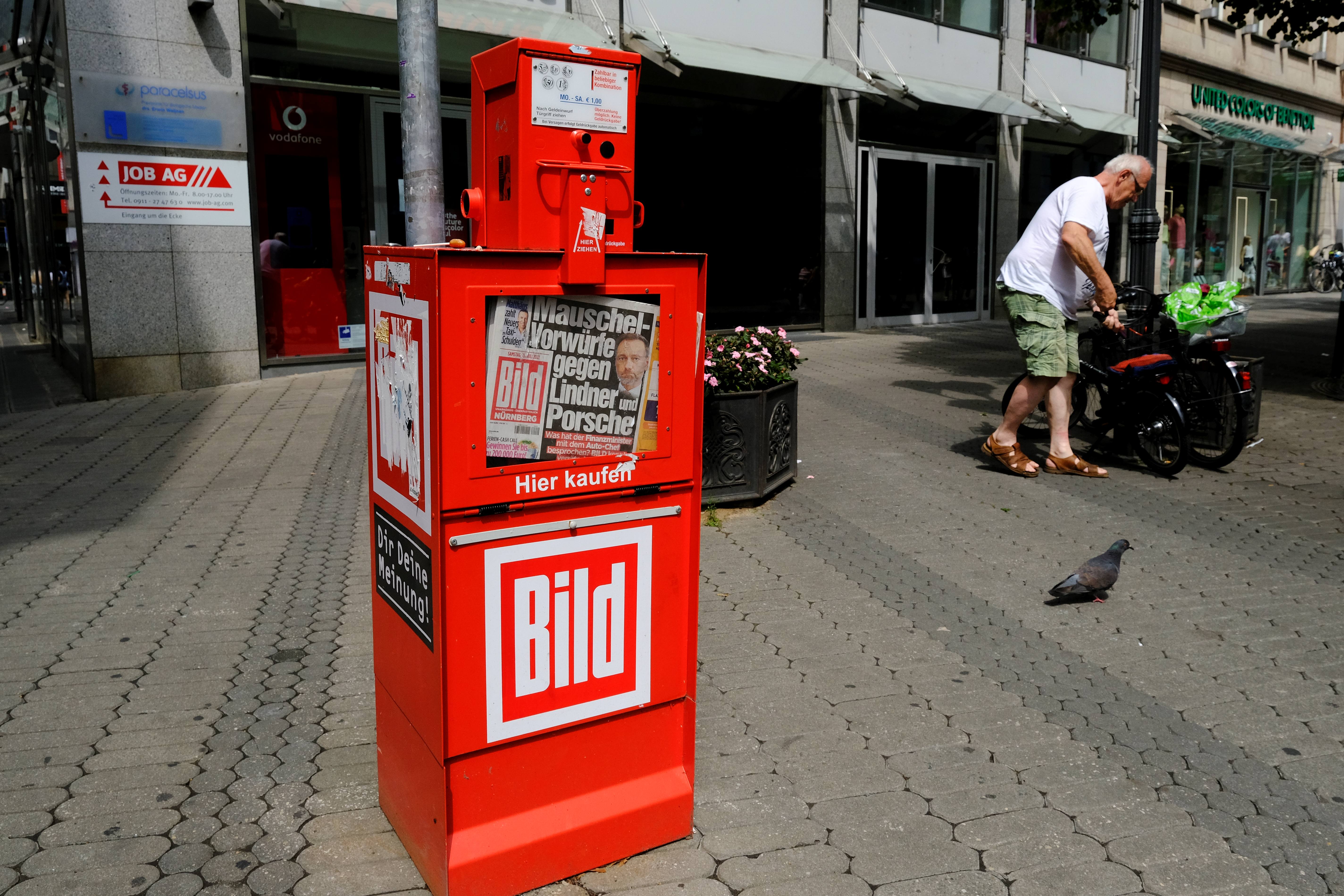
Bild Newspaper: The Story of Israel’s Propaganda Machine Specializing in Anti-Palestinian Incitement

It labelled Al Jazeera journalist Anas Al-Sharif, killed by the occupation, a “terrorist”; denies famine in Gaza; trains its journalists in Israel to promote the Zionist narrative; published forged documents leaked from Netanyahu’s office; and belongs to a media group whose charter affirms “support for Israel’s right to exist”. This is Bild, Germany’s newspaper of incitement against Palestinians, cited by Israel’s president.

Al Jazeera Journalism Review
Al Jazeera Journalism Review Published on: 7 Oct, 2025
Mental Health in Newsrooms

Newsrooms, long lauded as bastions of information, are quietly grappling with a mental health crisis, underscoring an urgent need for systemic support, emotional safety, and sustainable practices to protect those telling the world’s stories.

Faras Ghani Published on: 27 Sep, 2025
The Continent Experience: A New Kind of Newspaper for the Future of Journalism

The Continent is a new way of empowering people through quality journalism, blending the authority of newspapers with the reach of 21st-century distribution. Readers love it. That’s why we built it. It’s a model other newsrooms can learn from and one that comes with its own set of challenges.

Sipho Kings
Sipho Kings Published on: 28 Aug, 2025
Anas Al-Sharif’s Killing and the Israeli Media Narrative

Following the assassination of journalist Anas Al-Sharif, Palestinian journalists have been framed in Israeli media as legitimate military targets—part of a deliberate strategy to silence those who bear witness to the truth. This article explores how Hebrew-language media outlets have engaged in rhetoric that incites and legitimises the killing of journalists in Gaza.

Anas Abu Arqoub
Anas Abu Arqoub Published on: 19 Aug, 2025
Canadian Journalists for Justice in Palestine: A Call to Name the Killer, Not Just the Crime

How many journalists have to be killed before we name the killer? What does press freedom mean if it excludes Palestinians? In its latest strike, Israel killed an entire Al Jazeera news crew in Gaza—part of a systematic campaign to silence the last witnesses to its crimes. Canadian Journalists for Justice in Palestine (CJJP) condemns this massacre and calls on the Canadian government to end its complicity, uphold international law, and demand full accountability. This is not collateral damage. This is the targeted erasure of truth.

Samira Mohyeddin
Samira Mohyeddin Published on: 14 Aug, 2025
Monitoring of Journalistic Malpractices in Gaza Coverage

On this page, the editorial team of the Al Jazeera Journalism Review will collect news published by media institutions about the current war on Gaza that involves disinformation, bias, or professional journalistic standards and its code of ethics.

A picture of the Al Jazeera Media Institute's logo, on a white background.
Al Jazeera Journalism Review Published on: 11 Aug, 2025

From "Death Announcement" to "Eulogy": The Obituary as a Journalistic Genre

Obituaries for influential public figures have become a recognised journalistic genre, handled by seasoned reporters in major media outlets. How did this practice evolve, what defines it professionally, and how ethically acceptable is writing obituaries in advance?

Mahfoud G. Fadili
Mahfoud G. Fadili Published on: 17 Jul, 2025
Canadian Mainstream Media’s Orientalist Stance Towards Palestinians

Canadian mainstream media manufactures consent to support Israel through biased language, withholding historical context, and conflating any criticism of the Israeli state with antisemitism. When the Canadian mainstream media covers the question of Palestine, they usually frame it as a religious issue and withhold the historical and socio-political context.

Sarah Samuel-Ayyash
Sarah Samuel-Ayyash Published on: 14 Jul, 2025
Digital Dependency: Unpacking Tech Philanthropy’s Grip on Local News in the MENA

AI-driven journalism initiatives in the Middle East, often backed by philanthropic media development projects, are reshaping local newsrooms under the influence of global tech giants. These efforts, while marketed as support, risk deepening power asymmetries, fostering digital dependency, and reactivating colonial patterns of control through algorithmic systems and donor-driven agendas.

Sara Ait Khorsa
Sara Ait Khorsa Published on: 3 Jun, 2025