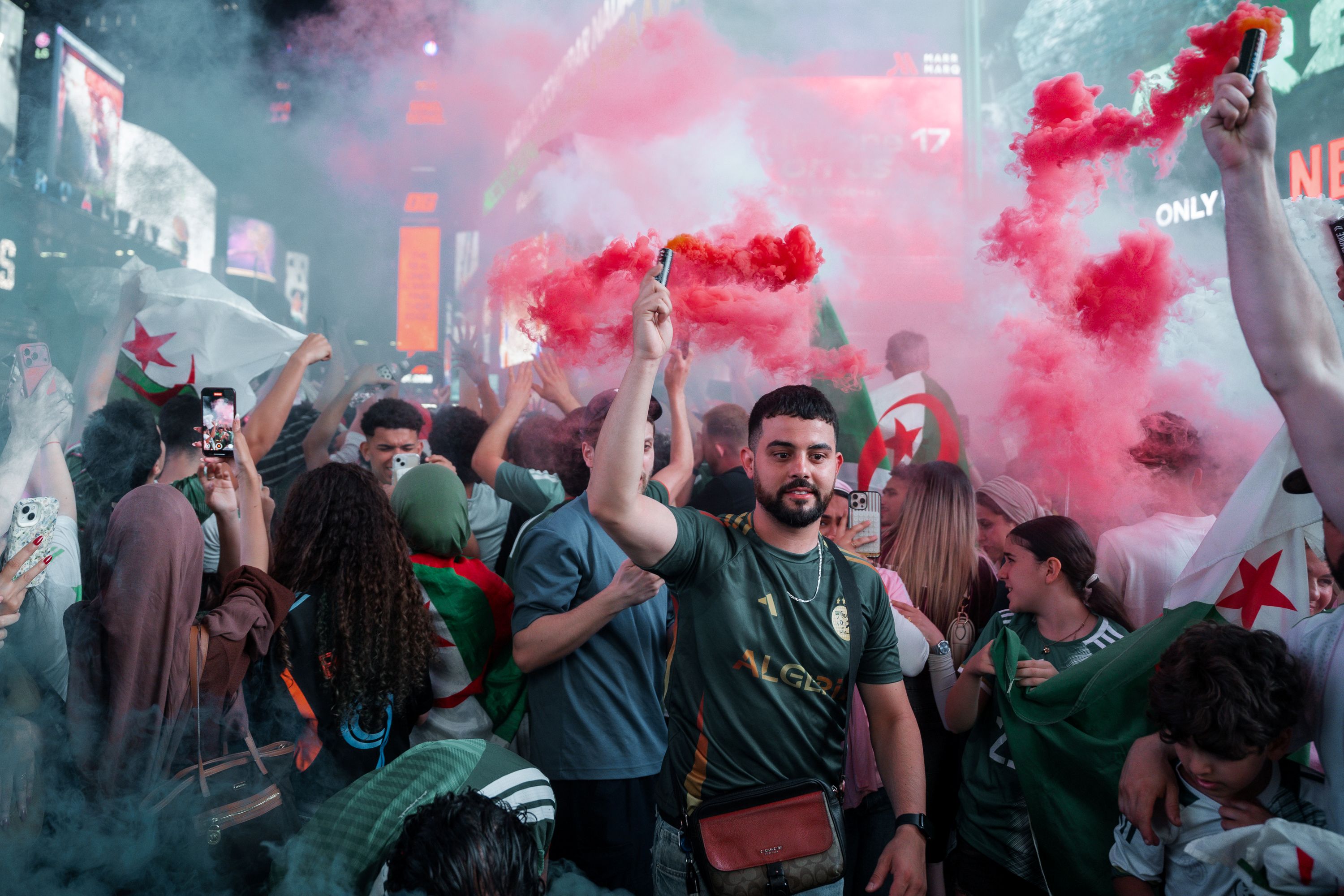

Open-source intelligence is turning sports journalism into a verification-heavy beat, where reporters must check fan videos, social posts, flight data, maps, prices and hashtags rather than simply cover matches. Sports events such as the 2026 World Cup will demand a wider journalistic eye: one that tracks fans, cities, transport, money, misinformation and organised digital campaigns without mistaking online noise for fact.
The World Cup is no longer a football event whose action takes place only inside the green rectangle, and its coverage is no longer the preserve of official broadcast cameras, press conferences, or coaches’ post-match statements. Today, in the 2026 edition spread across the United States, Canada and Mexico, the sports journalist finds himself facing a tournament that crosses borders, is geographically vast, and is densely packed with supporters.
These diverse spaces leave the journalist both puzzled and facing endless opportunities for news sources: from stadiums, airports, hotels, fan zones, transport networks, social platforms, flights, accommodation prices, digital campaigns, unexpected videos, and rumours that may spread faster than the referee’s whistle.
Here, precisely, dealing with open sources, OSINT, becomes an essential skill for the sports journalist. It does not replace the journalist in the stadium, nor does it dispense with interviews, technical expertise, or reading the match, but it gives the journalist an extra eye in places he cannot reach, a means of verifying what the public is circulating, and a way to discover coverage angles that do not appear in official bulletins.
From Sports Journalist to Verification Journalist
The first tasks of the sports journalist in this tournament are not only to describe goals and cover competitions, but also to deal with a vast torrent of material flowing across the internet. For example, one might stop at a video claiming to show a clash between supporters of two national teams, or an image claiming to show suffocating congestion outside a stadium, or a video of protests over transport arrangements, or a post about the delayed arrival of a national team, or a map claiming the collapse of services in a host city.
In such cases, the journalist must turn to the most important questions: Is this true? Where was it filmed? When was it filmed? Who published it first? And does it reflect a general incident or an isolated individual case?
One of the most prominent examples is the circulation of old videos in recent and improper contexts. For instance, accounts on social platforms circulated a clip claiming that it documented the arrival of fans of the Netherlands national team in the United States in preparation for the 2026 World Cup matches. Reverse search, however, revealed that the scenes were old, published in June 2024, and related to a gathering of Dutch fans in the German city of Hamburg before a match in the Euro 2024 championship.
The verification process begins by breaking the video down into still frames, then searching for them across multiple search engines and reverse-search tools, and comparing the results with the date of first publication, the language used, and the original context.
After that comes the geolocation stage, where the journalist becomes a visual reader of small details: a shop sign, the shape of a pavement, the colour of a bus, the type of streetlights, the façade of a railway station, a traffic sign, a stadium entrance, or even the shape of the mountains in the background if the filming was in a Mexican or Canadian city.
Videos published by fans provide invaluable material for the sports journalist. They capture what the official broadcast camera does not capture: a moment of confusion at a stadium entrance, a long wait at a railway station, an argument in a fan zone. At the same time, however, they may be among the materials most vulnerable to manipulation, whether by changing the context, combining sound with an image, cutting the shot out of its full sequence, or using a misleading caption.
Open-Source Videos are an Opportunity and a Trap
Videos published by fans provide invaluable material for the sports journalist. They capture what the official broadcast camera does not capture: a moment of confusion at a stadium entrance, a long wait at a railway station, and an argument in a fan zone. At the same time, however, they may be among the materials most vulnerable to manipulation, whether by changing the context, combining sound with an image, cutting the shot out of its full sequence, or using a misleading caption.
An example of this case: official accounts affiliated with Iranian embassies published a video claiming that it documented a huge display celebrating Iran’s national team during the World Cup opening ceremony in the United States. The scenes show giant models and visual displays inside a stadium, interspersed with symbols and elements inspired by Iranian heritage, which gave the clip a realistic character and helped it circulate.
Therefore, the journalist must not treat a fan video as definitive evidence from the first moment. They must subject it to a series of questions: Is the account that published it trustworthy? Was it actually published from the site of the event? Does the publisher have a previous record of original material? Are there other clips of the same incident from different angles? Does the audio match the image? Do the chants that appear actually belong to the national team mentioned? Are the signs, advertisements, clothes and stadiums consistent with the place and time?
The journalist must be precise in his language. Not every intense interaction is an organised campaign, and not every wave of popular anger is the work of electronic committees. What is required is to look for clear indicators such as: repeated wording, the pattern and timing of publication, the age of accounts, similarity in images, shared links, sudden jumps in hashtags, and the campaign’s movement between different platforms. When these indicators are present, the story becomes deeper than mere sporting anger; it becomes a story about how opinion around the tournament is manufactured.
Coverage Angles Beyond the Pitch
Open sources give the sports journalist the ability to broaden the concept of coverage. The World Cup is not only matches, but a huge system within which fans, authorities, companies, organisers and national teams move.
Among the most important possible angles is tracking the unfiltered fan experience, whereby the journalist can monitor what the public publishes about its movements towards or away from the stadium in order to compare the official narrative about the organisation with the daily experience of supporters.
Here, the journalist raises vital questions such as: Is transport smooth? Is the congestion normal? Have prices risen? Are there problems with tickets? Does the experience differ from one city to another?
Tracking the movement of teams and fans represents another angle. Public flight data can be used to understand the pattern of national teams’ movements between cities, to analyse pressure on airports before major matches, or to monitor the impact of long distances between host cities on rest and preparation.
A video published by accounts on X shows a large flow of Egyptian fans in the streets of the US city of Seattle ahead of their national team’s match against Belgium. The video reveals huge crowds marching towards the stadium. Here, the journalist quickly turns to Google Maps to reveal the nature of congestion in this area, the clear roads, and the other routes to the stadium.
But this data must not turn into a detailed disclosure of where players are staying, the movements of their families, or information that could affect their safety and privacy. Here, the journalist is required to balance the public’s right to know with individuals’ right to safety.
There is also the hidden economy of the World Cup, where the journalist can monitor short-term accommodation prices in host cities before and after matches, and follow how prices change when a team with a large following qualifies or is eliminated. The data may reveal the tournament’s relationship with local residents and its repercussions for them. The journalist’s role in this case is to provide deeper context and entry points for understanding new dimensions of the tournament.
Monitoring Public Mood and Organised Campaigns
In every major tournament, social platforms turn into a parallel pitch. A single refereeing decision may trigger a digital storm, and a player’s mistake may make him the target of smear campaigns, and so on. Here, the sports journalist can use social listening tools to monitor trends in the discussion: are they genuine and spontaneous, or driven by fake accounts?
The journalist must focus on exposing organised campaigns. The appearance of thousands of posts in the same wording, at similar times, and from recently created accounts means that we are facing an “amplification network”, not a natural public opinion. Such networks may target a player, a referee, a national federation, or even a host country.
We can recall how American and Israeli accounts exploited the hosting of the 2026 World Cup to intensify digital campaigns against the mayor of New York, Zohran Mamdani, by clipping his appearances at matches and his official messages, and distorting his use of Arabic in misleading political and religious contexts.
In such cases, the journalist must be precise in his language. Not every intense interaction is an organised campaign, and not every wave of popular anger is the work of electronic committees. What is required is to look for clear indicators such as: repeated wording, the pattern and timing of publication, the age of accounts, similarity in images, shared links, sudden jumps in hashtags, and the campaign’s movement between different platforms. When these indicators are present, the story becomes deeper than mere sporting anger; it becomes a story about how opinion around the tournament is manufactured.
The same applies to tickets, where open sources make it possible to track black-market networks in order to monitor prices and patterns of fraud so as to warn the public against becoming involved in dealing with them.
Covering the 2026 World Cup through open sources is not merely a technical exercise. It is a transformation in journalistic thinking. The journalist is no longer simply a transmitter of what happens in the match, but is now required to read the entire field in which the tournament moves, with all its details: the public, cities, transport, money, the environment, platforms and rumours, all the way to analysis from new angles.
Sports Journalism with a Wider Eye
Covering the 2026 World Cup through open sources is not merely a technical exercise. It is a transformation in journalistic thinking. The journalist is no longer simply a transmitter of what happens in the match, but is now required to read the entire field in which the tournament moves, with all its details: the public, cities, transport, money, the environment, platforms and rumours, all the way to analysis from new angles.
In this World Cup, the story may come from a fan’s shot in the stands, a shadow appearing in a short video, a sudden rise in apartment prices, a long flight between two cities, or an angry hashtag driven by fake accounts. Amid all this, the essence of journalistic work remains constant: do not publish before verifying, do not settle for what the official camera shows, and do not be deceived by the noise of the platforms.