Al Jazeera Journalism Review

Anas al-Sharif: “I am the owner of a cause before I am a journalist”

Edited by: Mohammed Ahddad 

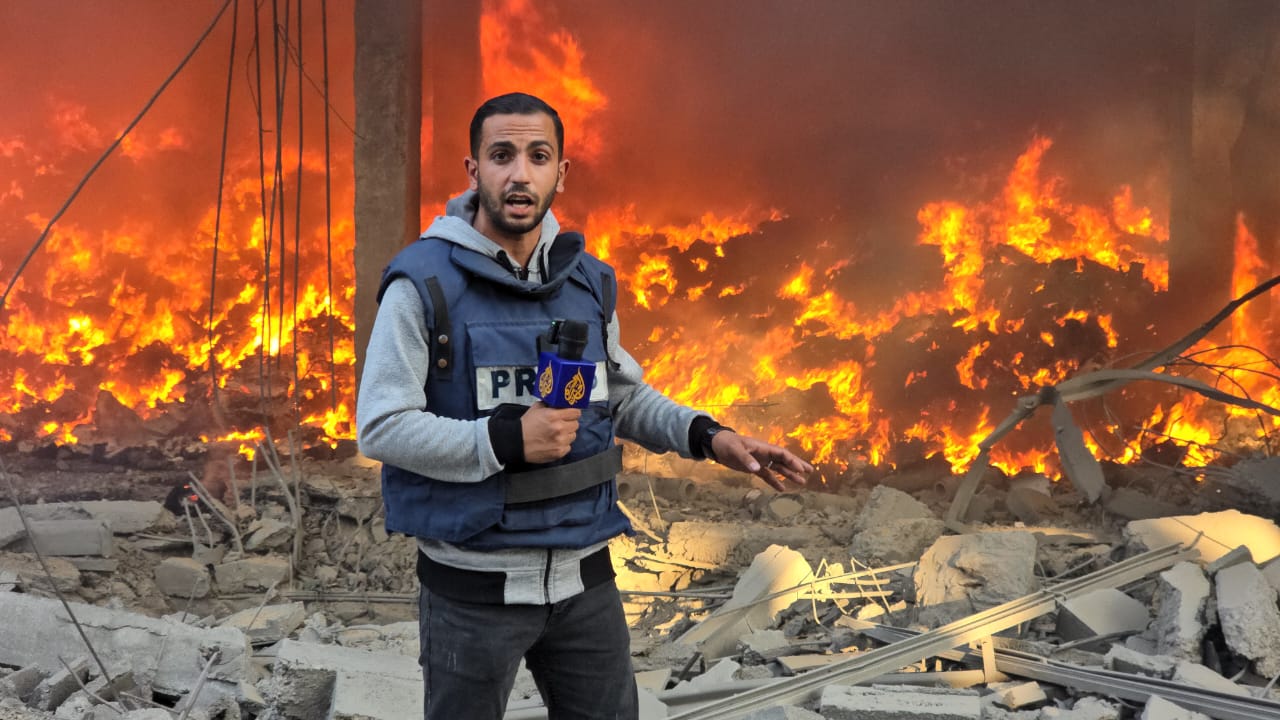
The story began with the publication of video clips and images of places targeted by the occupation on social media platforms, and ended with threats and warnings that family members would be bombed. The story of the Palestinian journalist Anas al-Sharif, who became a correspondent for Al Jazeera, does not seem very different from the stories of hundreds of Palestinian journalists who suddenly found themselves documenting the occupation’s ongoing crimes in the Gaza Strip and across occupied Palestine. 


A Palestinian Narrative at Any Cost 

Anas tells Journalism Magazine his story of documenting the occupation’s crimes: “Since 7 October, I began publishing on my personal pages on social media platforms and through international, local and global agencies. The aim was to get the image out of northern Gaza amid the siege imposed by the occupation on the entry of foreign journalists. The truth is that this period laid the foundations for my joining Al Jazeera, which I used to supply with videos and reports before colleague Tamer contacted me and said to me clearly: go out with a report showing your face and personality, speak, and end the report with: Anas al-Sharif for Al Jazeera.” 

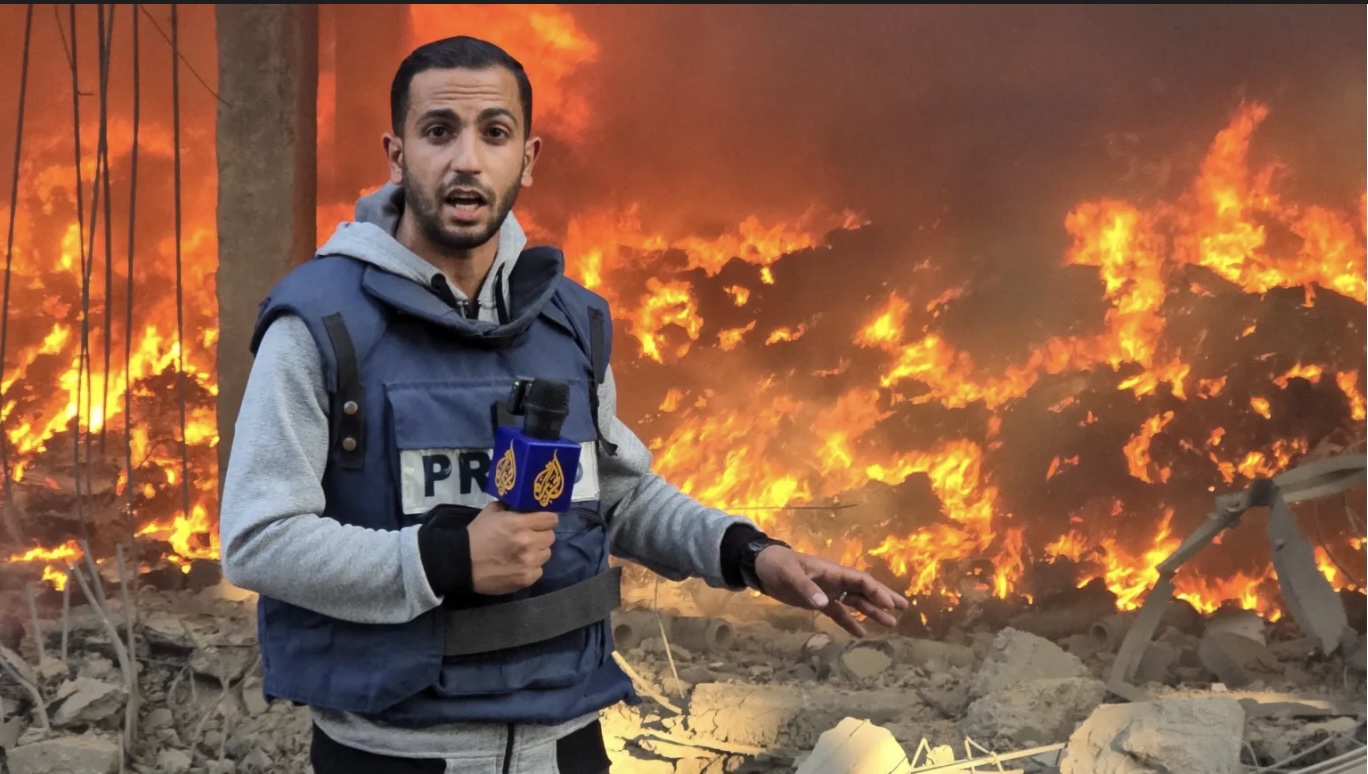
Anas al-Sharif moved from documenting crimes on his digital platforms to working for Al Jazeera, whose journalists have been directly targeted since the beginning of the war of genocide. Anas al-Sharif remembers his first report broadcast on the channel: “It was about a strike in Jabalia targeting warehouses storing timber, cleaning materials and chemicals. I appeared with my face visible, and the truth is that those were difficult moments and something new for me; because I had been working behind the scenes, whereas now I was appearing in person on the biggest channel.” 

The career of Anas al-Sharif, who is considered one of the few journalists who continued reporting from northern Gaza, was not free of confrontation with the Israeli occupation. “I received several calls from the occupation on my personal phone, and I did not answer them at all and did not respond to their messages. They did not stop there. I received voice recordings on WhatsApp from an officer in Israeli intelligence calling on me to stop covering events, leave northern Gaza and head south, otherwise I and my family would be targeted.” Yet the answer of Anas, who graduated from Al-Aqsa University, specialising in radio and television, was clear: “My family and I will not leave the northern Gaza Strip, and we have not thought about the decision for even a single moment. We are the people of Jabalia camp. We lived in this camp, and many wars have passed over us and we did not leave for a single moment throughout the previous years. As for my father’s decisive decision, it was not to leave at all. This threat only increased my determination to continue coverage.” 

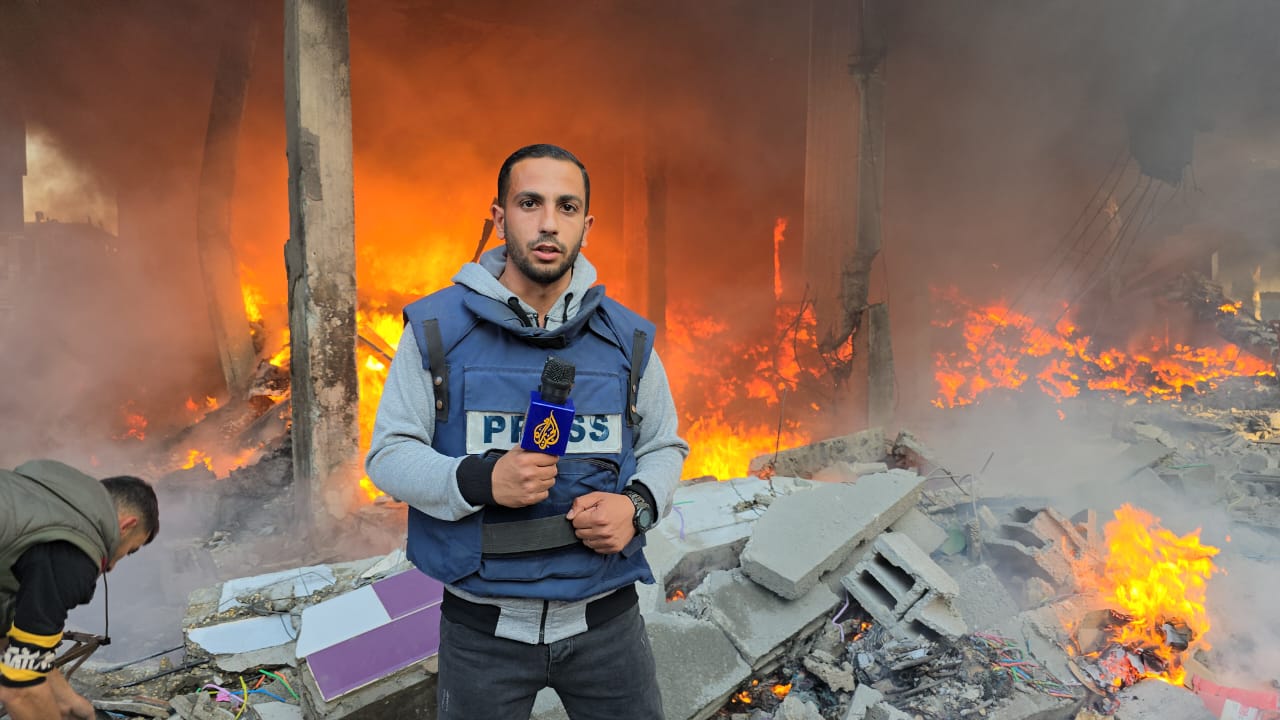
The occupation carried out its threat, targeting Anas’s home and his family’s home. “My father, may God have mercy on him, was martyred. He had insisted on staying and not leaving Jabalia camp despite the threats and despite everything. This is a price paid by every citizen living in the Gaza Strip, and my tragedy is no different from that of millions of Palestinians. Away from the emotions left behind by this killing, I feel that I belong to this cause and that I am bound by the duty to convey the suffering of Palestinians to the world.”
1
The occupation carried out its threat, targeting the home of Anas's family: "My father, may God have mercy on his soul, was martyred. He insisted on staying and refusing to leave the Jabalia camp despite the threats and everything else. This is a tax paid by every citizen living in the Gaza Strip."

The occupation carried out its threat, targeting Anas’s family home: “My father, may God have mercy on him, was martyred. He had insisted on staying and not leaving Jabalia camp despite the threats and despite everything. This is a price paid by every citizen living in the Gaza Strip.” 


Absent Protection 

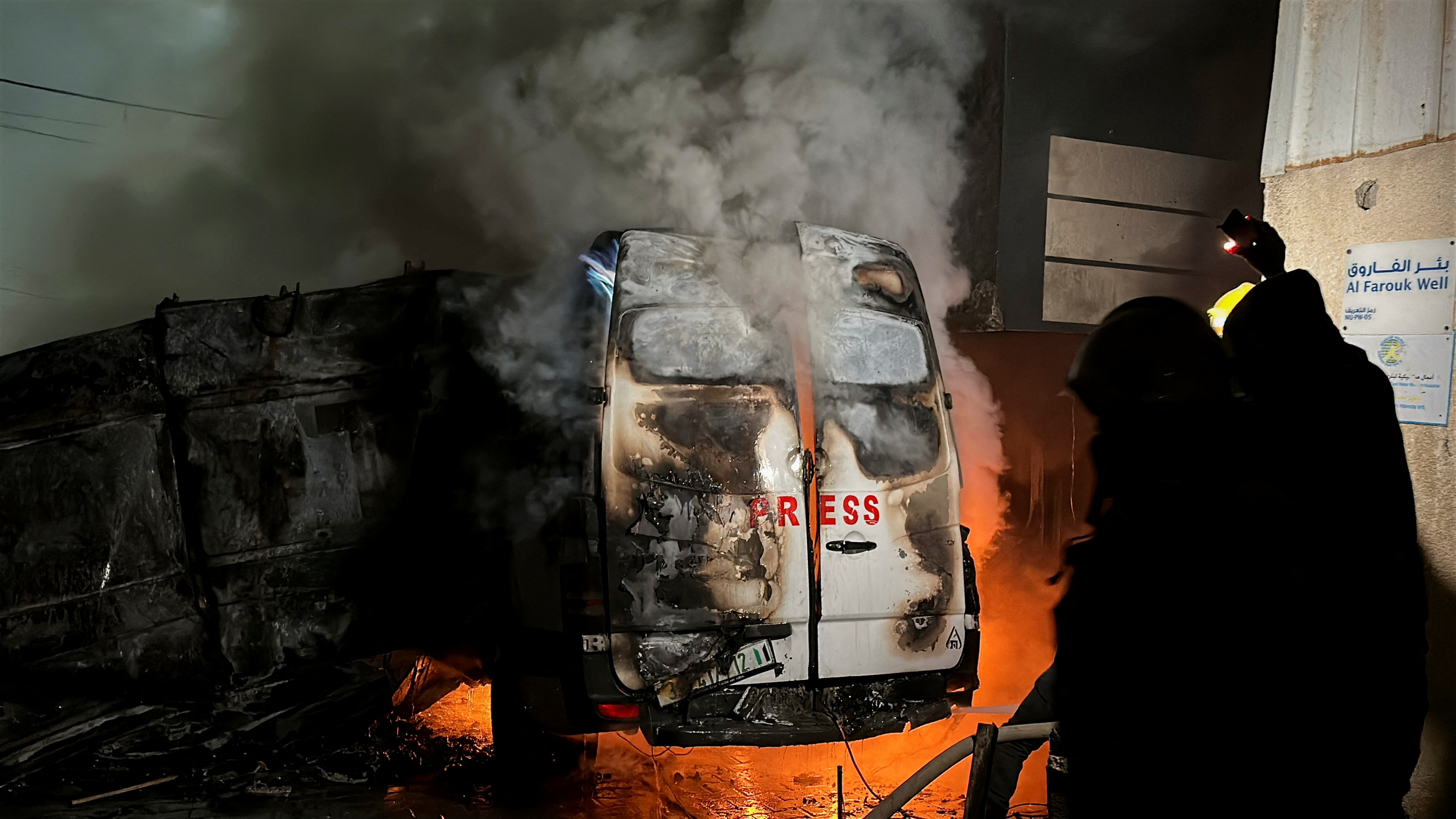
The literature has traditionally identified the risks of practising journalism in areas of war and conflict in order to help improve the quality of coverage and protect the personal safety of journalists. But practising journalism in Palestine, and in Gaza where the war of genocide has continued for more than six months, appears to be a different experience. In Anas’s view, the occupation “left no safe place in the northern Gaza Strip; it targeted the hospitals from which we were conveying people’s suffering, and it targeted schools, shelter centres, ambulances... In other words, there was not a single place left in Gaza where the recognised safety measures could be taken. What made us feel bitterness was the absence of protection for journalists, whether from international institutions or local organisations.” 

Anas does not want to answer the question of international protection for journalists and recognition of them, contenting himself with saying: “Perhaps I do not want to answer this.” He explains this brevity by saying that “no international, local or regional institution has been able to protect journalists in the Gaza Strip, despite the occupation committing many crimes against them, targeting them and opening fire on them. What has been provided to them so far is insufficient, because the risks are very high; they affect not only them but also their families.” 

Anas’s message to the international, local and regional institutions that sing the praises of journalistic work and the protection of journalists is “to look at the Palestinian journalist who is exposed to extreme danger and subjected to bombing and massacres, along with his family, and to provide him with protection; because he is the last voice of what is happening in Gaza now.” 

According to the figures available so far, the occupation has killed more than 140 journalists; that is to say, Palestine has become an environment in which journalistic work is impossible. Despite this, Anas believes that conveying the narrative of what is happening in Gaza from the field makes you feel “that you are offering something positive to people amid the continuation of massacres and starvation... When I convey the suffering of one of the people of Gaza, I feel that I have made even a small contribution to my cause before being a journalist. This has been my cause since I was born here in Gaza, in Jabalia camp. Therefore, before I am a journalist, I am the owner of a cause that I am trying to convey to the world.” 

Anas does not want to answer the question of international protection for journalists and recognition of them, contenting himself with saying: “Perhaps I do not want to answer this.” He explains this brevity by saying that “no international, local or regional institution has been able to protect journalists in the Gaza Strip, despite the occupation committing many crimes against them.


The Power of the Field 

Anas al-Sharif answers the question about the beginnings of his field journalism work: “I started as a photojournalist, conveying field events from the Gaza Strip and specifically from the north of the Strip, whether popular and local activities or the activities of the Palestinian factions. I conveyed the suffering of prisoners’ families and documented the Great March of Return and the breaking of the siege on the eastern borders of the Gaza Strip. All my work was limited to photojournalism, and I received many awards in recognition of my coverage of the March of Return and the breaking of the siege.” 

The fundamental shift or turning point in his professional path came on the day of the 7 October attack. “It was completely different in my professional experience, and what helped me was that I had worked as a photographer preparing the material, then editing it and choosing the angles of treatment. In other words, I worked as a correspondent, producer and mobile-phone photographer.” 

Anas recounts the first hours of the 7 October attack and the extent to which journalists were prepared for field coverage. What happened “was surprising to everyone, and with the pace of events accelerating, we did not make any arrangements as in previous wars. The field imposed the form of coverage on us. We were racing against time without any prior arrangements, given the large scale of massacres in different places. I want to point out here that, as events developed, field coverage improved and we began to focus on the massacres despite the harshness of what we were seeing.” 

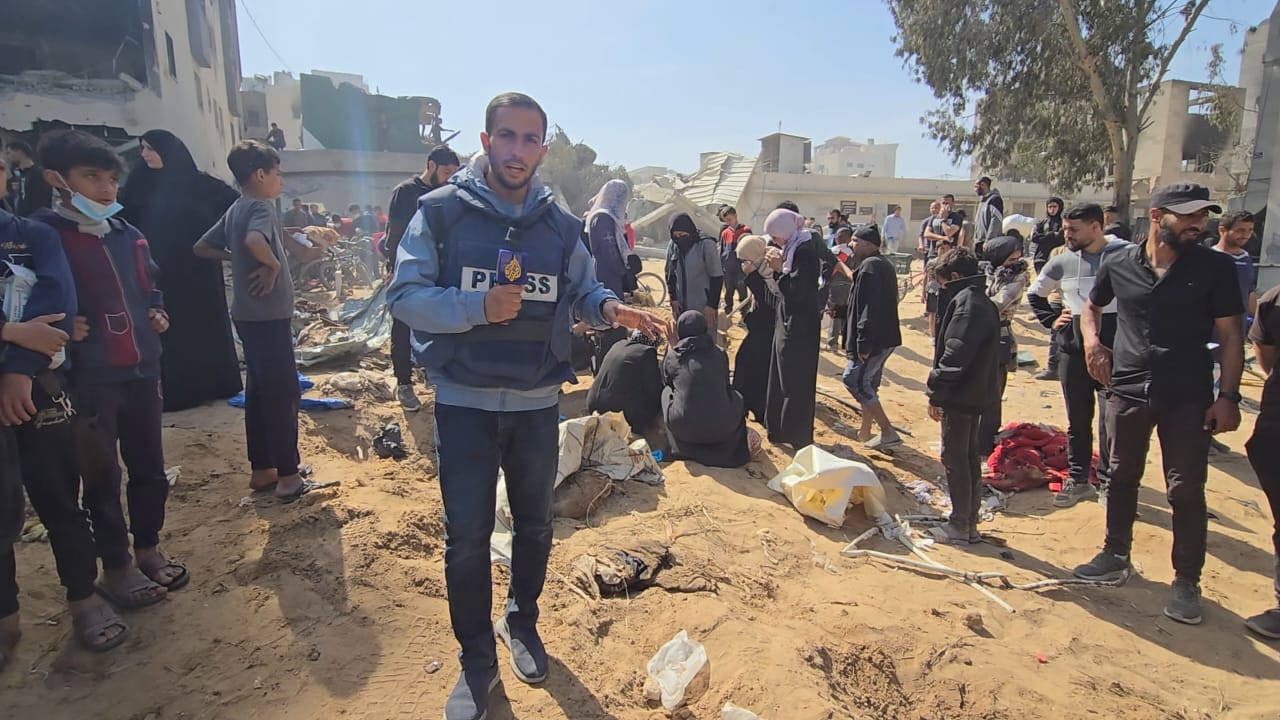
The experience of journalistic coverage in Gaza differs from that in other war zones. For more than six months of the war of genocide, journalists reported exceptional challenges represented by the absence of services and the cutting off of electricity and communications. Anas al-Sharif challenges these conditions, saying: “I did not stop covering for a single moment. I would move across the roofs of homes and hospitals looking for an internet signal, with all the risks that accompanied that, given that we were being directly targeted. After four hours of waiting and hardship, the report would be sent after time had already passed since the massacres, but my concern was that the voice of the north should remain present. In fact, at certain moments I became unable to make direct calls, contenting myself with voice recordings only.” 

Anas’s ordeal with journalistic coverage in Gaza is a summary of the ordeal of the few journalists who remained in the north, “risking ourselves, using eSIMs even if they involved danger; what mattered most was that the image from the field should remain present.” 
1
"When I report on the suffering of someone from Gaza, I feel that I have made even a small contribution to my cause before being a journalist. This has been my cause since I was born here in Gaza, in the Jabalia camp. Therefore, before being a journalist, I am a defender of a cause that I am trying to convey to the world."

Solidarity among journalists was the last line of defence in preserving the value of journalism, as Anas recounts: “We were brothers to one another. We moved together from one place to another, documenting the occupation’s crimes from different angles. The experience showed that the occupation deliberately bombs journalists. For example, while colleague Mohammed Arab was documenting the destruction in the Tel al-Zaatar area near the Indonesian Hospital, warplanes fired three missiles directly towards the journalists.” 

At the beginning, we wondered whether to publish this interview in the traditional format, governed by question and answer, or to make it convey the spontaneity of the answers. The decision settled on the second option. But Anas’s final message we leave as it is, without editing or arrangement: 

“I have documented many massacres, bombings, homes collapsing on the heads of their residents, and major massacres whose number of martyrs reached the hundreds. But none of that pained me more than the period of famine that northern Gaza went through. People here endured massacres and the blood of the martyrs, and were patient through separation and everything else, but they could not bear the famine and the screams of children at night, and families roaming and moving from one place to another as they appealed to the world for one meal for one day for their children. I suffered from that personally. I mean, we could not find bread or rice or canned food. I mean, days would pass when we could not provide a single meal. Despite that, we resisted as much as we could, and continued coverage until the last moment and the last breath.” 

Update: The number of Palestinian journalist martyrs had reached 264 by 10 August 2026 

This article was origianlly published in Arabic on 3 Jun, 2024 
Related Articles

Anas Al-Sharif’s Killing and the Israeli Media Narrative

Following the assassination of journalist Anas Al-Sharif, Palestinian journalists have been framed in Israeli media as legitimate military targets—part of a deliberate strategy to silence those who bear witness to the truth. This article explores how Hebrew-language media outlets have engaged in rhetoric that incites and legitimises the killing of journalists in Gaza.

Anas Abu Arqoub
Anas Abu Arqoub Published on: 19 Aug, 2025
Anas Al Sharif; Killed by Israel, but His Final Words Will Echo far Beyond His Death

For over a year and a half, Anas Jamal al-Sharif refused to leave northern Gaza, documenting the destruction and loss that others tried to hide. Tonight, Israel silenced his voice, but his final words, written on April 6, will echo far beyond his death.

Al Jazeera Journalism Review
Al Jazeera Journalism Review Published on: 11 Aug, 2025
The Gaza Journalist and the "Heart and Mind" Struggle

Inside the heart of a Palestinian journalist living in Gaza, there are two personas: one is a human who wants to protect his own life and that of his family, and the other is a journalist committed to safeguarding the lives of the people by holding on to the truth and staying in the field. Between these two extremes, or what journalist Maram Hamid describes as the struggle between the heart and the mind, the Palestinian journalist continues to share a narrative that the occupation intended to keep "away from the camera."

Maram
Maram Humaid Published on: 18 Aug, 2024
Journalists feel the pain, but the story of Gaza must be told  

People don’t always want to hear the historical context behind horrifying events, resorting even to censorship, but the media must be free to provide it

Aidan
Aidan White Published on: 30 Oct, 2023

More Articles

As in Rwanda: Can the Israeli Press Be Prosecuted for Participation in Genocide?

Israeli media incitement has helped frame Palestinian journalists as security threats, weakening their legal and professional protection and legitimising attacks against them. Legal accountability is possible through the ICC, universal jurisdiction, and professional pressure against journalists and outlets that incite violence.

Nasser Adnan Thabet Published on: 8 Aug, 2026
Can Africa’s Media Decolonise Climate Story?

Despite efforts in combating climate change and finding climate solutions in the Africa, the continent’s climate story is still told through the lens of colonisation. The dominant stories centre on the victimhood; especially during climate disasters. Such stories don’t mention the side of the continent’s efforts to adapt to climate change.

Jean-Pierre Afadhali Kenyan journalist
Jean-Pierre Afadhali Published on: 21 Jul, 2026
The Phenomenon of “News Avoidance”: Have We Come to Know More Than We Should?

Audiences are increasingly avoiding the news as the constant flow of crises, violence, and tragic human stories creates psychological exhaustion and anxiety. Media outlets need to respond with more responsible editorial choices, stronger media literacy, and coverage that balances urgent events with constructive, humane, and less harmful storytelling.

Wessam Kamal Published on: 17 Jul, 2026
In Gaza… Testimonies That Have Not Been Told

Beyond the frontline dangers, reporting during the Israeli war involves enduring arrest, torture, systematic incitement, and assassination. This reality forces journalists into a relentless struggle to keep reporting from the depths of mass displacement, starvation, and a complete breakdown of daily infrastructure.

Mohamed Abu Qamar Published on: 8 Jul, 2026
When Modi’s Managed Media Met Europe’s Press

A brief, viral exchange in Oslo between Prime Minister Narendra Modi and a Norwegian journalist has exposed the widening gap between India's tightly controlled media environment and traditional adversarial press culture. Over the past decade, open, unscripted scrutiny has increasingly been replaced by carefully managed public relations, image-driven interviews, and direct digital reach. This systemic shift has reshaped the broader landscape of Indian news media, creating a culture of forced deference that prioritises political showmanship over holding power accountable.

Arsalan Bukhari, an independent journalist based in India
Arsalan Bukhari, Mehrunnisa Maryam Published on: 5 Jul, 2026
The Left and the Right in One Front Against Journalism in South America

Journalism in Latin America is facing a crisis of hostility. In the age of political polarization, governments from both the left and the right are not merely managing states; they are actively harassing critical voices, imposing institutional censorship, and enforcing official narratives that attack independent media to silence disagreement and fake democracy across the region.

Noe Zavaleta
Noe Zavaleta Published on: 8 Jun, 2026
Humanitarian Storytelling: Reclaiming Voice in Crisis Reporting

Humanitarian storytelling is evolving. In the age of algorithmic amplification, humanitarian organisations are not merely sharing aid updates; they work side by side with responsible media; they are providing accountability, combating harmful narratives, and demonstrating the human reality behind the crisis and news headlines.

Shereen Nanish. A media consultant from Palestine/Jordan with over 10 years of experience in journalism and humanitarian communications. Based in Germany.
Shereen Nanish Published on: 1 Jun, 2026
On the Misunderstanding Between Media and Diplomacy

The analysis of international crisis coverage reveals a clear structural gap between the immediate, simplified narratives produced by the media and the slow, complex processes of diplomacy. The tension between the two fields appears set to persist as reporters are forced to trade detailed, long-term tracking of negotiation for fast-paced, dramatic framing and the immediate demands of the attention economy.

Said Al-Azri
Said Al-Azri Published on: 28 May, 2026
How Journalists are Combating Cybertroopers 

The brutal state crackdown in Đồng Tâm highlights a intensifying withdrawal from free expression in Vietnam, heavily driven by the regime's deployment of state-backed cyberarmies like Force 47. As these digital actors systematically intimidate and mass-report critics, tech giants like Meta further compound the issue by increasingly acquiescing to government censorship requests to protect market share. This coordinated digital assault leaves a dangerous gap in the global conversation, forcing independent journalists to navigate severe online hostility and risk arbitrary imprisonment just to expose state overreach.

AJR Contributor Published on: 25 May, 2026
Journalism After the Genocide in Gaza: One War Has Ended, and Other Wars Have Begun!

The post-ceasefire reality for Gaza’s journalists reveals a challenging shift from documenting active daily bombardment to navigating an overwhelming landscape of community and structural ruin. The pressure on reporters appears set to escalate as they struggle to rebuild their own lives from absolute zero while fighting to ensure that ongoing human suffering, systemic displacement, and political marginalization are accurately documented and held to account.

Yousef Fares
Yousef Fares Published on: 17 May, 2026
US-Iran Islamabad Talks: How Journalists Report from Outside Closed Doors

The "Islamabad Talks" highlight a growing contradiction in modern diplomacy where journalists are physically present but denied direct access to negotiations. The pressure on transparency appears set to intensify as reporters are forced to trade traditional eyewitnessing for outside in investigation and geopolitical speculation.

Anam Hussain
Anam Hussain Published on: 2 May, 2026
Can Artificial Intelligence Become a Documentary Film Director?

AI opens new possibilities in documentary filmmaking, from sorting archives to speeding up production. But documentary is not built on technology alone: it depends on the director’s vision, creativity, and ability to shape meaning. Can AI, for instance, make a film like Ordinary Fascism?

Bashar Hamdan, investigative producer and documentary filmmaker at Al Jazeera Media Network
Bashar Hamdan Published on: 23 Apr, 2026
When Speaking Up Backfires: How Social Conformity Silences Journalists

While state censorship remains a reality, freedom of speech in Africa faces a rising internal threat: the community itself. This article examines how social conformity, digital echo chambers, and ingrained bias create a modern "chilling effect". This pressure forces journalists to choose between aligning with popular narratives or facing professional and social marginalisation.

Derick Matsengarwodzi
Derick Matsengarwodzi Published on: 16 Apr, 2026
Has the Global South Benefited from the Digital Transformation?

Despite the promise of digital technologies to amplify voices and expand media reach in the Global South, structural barriers, such as political repression, technological dependency, and persistent digital divides, continue to limit their impact. Real progress requires not only technological adoption but also institutional reform, stronger journalistic capacity, and independent ethical frameworks to challenge dominant Western media narratives.

Al-Shafi Abtidon
Al-Shafi Abtidon Published on: 18 Mar, 2026
Missiles Made of Words: How Western Media Narratives Shape the Iran–Israel–US Conflict

Western media coverage of the Iran–Israel–US conflict often functions as a weapon of war, using selective language that frames US and Israeli strikes as “self-defence” while depicting Iranian actions as "provocation". This linguistic framing normalises civilian casualties and helps manufacture public consent for military aggression by dehumanising certain populations.

Muqeet Mohammed Shah
Muqeet Mohammed Shah, Ifrah Khalil Kawa Published on: 14 Mar, 2026
How the Ethiopian Civil War Unleashed a Lethal Media Crackdown

There has been a widening crackdown on the media in Ethiopia since war erupted between the central government and Tigray’s regional authorities in 2020, and the pressure appears set to intensify as the country prepares for general elections in June.

Nalova Akua
Nalova Akua Published on: 9 Mar, 2026
Are Netanyahu's and Trump’s Speeches Shaping Western Media Framing?

As political speeches framed the 2026 U.S.–Israeli attack on Iran, segments of Western media echoed their language and narratives, illustrating how strategic rhetoric and news framing can shape public opinion and legitimise military action.

Shaimaa Al-Eisai
Shaimaa Al-Eisai Published on: 6 Mar, 2026
Journalism in Gaza… A Race Against the Train of Genocide

In the following account, Amira Nassar presents a narrative filled with intricate detail, intimate exchanges, and an unyielding struggle over the meaning of writing amid slaughter and starvation. Part of The Journalism Review’s documentary project recording the testimonies of journalists in Palestine and the Gaza Strip during the ongoing genocide, it stands as a testament against oblivion and the machinery of extermination.

Amira Nassar
Amira Nassar Published on: 27 Feb, 2026
Kukurigo: Revolutionising news in Zimbabwe's WhatsApp era

The emergence of Kukurigo during Zimbabwe’s 2018 elections marked a turning point for digital journalism, transforming WhatsApp from a hub for misinformation into a vital platform for verified news. By leveraging the app’s low data costs, this grassroots initiative bridged the information gap for under-resourced communities, establishing a new model for media credibility and public service within an unstable political landscape.

Enock Muchinjo
Enock Muchinjo Published on: 19 Feb, 2026
The Epstein Files and the Art of Drowning the Truth

The mass release of millions of files related to Jeffrey Epstein serves as a metaphor for a wider crisis of the digital age: an overabundance of information that obscures rather than illuminates the truth. In an era where data floods replace traditional censorship, citizens risk becoming less informed, underscoring the vital role of professional journalism in filtering noise into meaningful knowledge.

Ilya إيليا توبر 
Ilya U Topper Published on: 12 Feb, 2026
Reporting the Spectacle: Myanmar’s Manufactured Elections

Myanmar’s recent elections posed a profound challenge for journalists, who were forced to navigate between exposing a sham process and inadvertently legitimising it. With media repression intensifying, reporting became an act of resistance against the junta’s effort to control information and silence independent voices.

Annie Zaman
Annie Zaman Published on: 7 Feb, 2026
Public Hostility Toward Legacy Media in Bangladesh

The December 2025 arson attacks on Prothom Alo and The Daily Star marked a turning point for journalism in Bangladesh. As public anger replaces state control as the primary threat, reporters are reassessing personal safety, editorial judgement, and professional credibility in a political transition where journalism itself is increasingly treated as an enemy.

Arsalan Bukhari, an independent journalist based in India
Arsalan Bukhari Published on: 4 Feb, 2026
Migration Issues and the Framing Dilemma in Western Media

How does the Western press shape the migration narrative? Which journalistic frames dominate its coverage? And is reporting on anti-immigration protests neutral or ideologically charged? This analysis examines how segments of Western media echo far-right rhetoric, reinforcing xenophobic discourse through selective framing, language, and imagery.

Salma Saqr
Salma Saqr Published on: 31 Jan, 2026
From News Reporting to Documentation: Practical Lessons from Covering the War on Gaza

From the very first moment of the genocidal war waged by Israel on Gaza, Al Jazeera correspondent Hisham Zaqout has been a witness to hunger, devastation, war crimes, and the assassination of his colleagues in the field. It is a battle for survival and documentation, one that goes beyond mere coverage and daily reporting.

Hisham Zakkout Published on: 26 Jan, 2026