From the pro-occupation Israeli character 'Srulik' to the resilient and satirical Palestinian 'Handala', caricature emerges as another battleground for memory and the future. How did these characters come to be, what is their media symbolism, and why does caricature remain so influential?
From the beginning, the Israeli narrative needed more than journalistic discourse and diplomatic activity in order to take root in the Jewish and Western mindset and to lend its appearance the features of “innocence” and the relentless pursuit of the Israeli promise. For this reason, its actors mobilised all their capacities to reinforce it.
Among these capacities was “caricature” and its artists, who found in it the force of the article and the compression of discourse in a way that served their efforts in peace and war and strengthened the manufacture of a unified public opinion. With this doctrine, “Srulik” was born on the pages of Israeli newspapers and later Sabra and then Captain Israel, together contributing to an organised propaganda effort to justify wars and rally support behind the Israeli narrative.
At another time, Handala appeared, determined to protect the narrative of the victim and of resistance without flattery and without compromise, until his creator was made to die while Handala himself was scattered across the roads of exile, searching for return. Between Srulik and Handala, the following lines extend to revisit their beginnings, examine their personal features within a broader narrative, and arrive at the role they perform as symbolic weapons in the battle to shape the story and mobilise public opinion.
Israel, the Innocent Boy
Shortly before the Nakba, the Hungarian Jew Goldberger migrated to Palestine. Upon his arrival, he changed his name to Kariel Gardosh and joined the Lehi, or Stern, gang, which sought to expel the British authorities from Palestine, allow unrestricted Jewish immigration, and establish a Jewish state. After a series of attacks, which Gardosh followed by taking part in the assassination of the UN Security Council mediator Count Bernadotte, he was arrested and tried on charges of belonging to a terrorist group before later being pardoned and joining the staff of the Maariv newspaper.
After that, Gardosh changed his name to "Dosh" and then began drawing a daily caricature reflecting political realities before becoming involved in writing articles, stories, and plays. Three years later, Dosh’s caricature work turned into a systematic effort to create a personified symbol of Israel in the style of other Western symbols, such as America’s Uncle Sam and Britain’s John Bull. It bore the name “Srulik”.
Srulik’s basic visual features were accumulated in a set of symbols that reinforced the visual identity of Israeli nationalism. He is a boy named Yisrael, white-skinned, under the age of ten, born in the land in the image of the Sabra generation, the first generation of Jewish immigrants after the Nakba. On his head is a cloth hat, the Kova Tembel, associated with the early settlers of the Yishuv and the kibbutzim.
Srulik wears short khaki trousers, suggesting readiness for work, and popular leather sandals known as 'Biblical sandals', a symbol of asceticism and toil in Jewish Talmudic heritage. As for his facial features, they suggest spontaneity and simplicity, turning him into an integrated propaganda system that combines innocence, simplicity, work, and toil on the land. The Srulik generation then became a basis for Israeli legitimacy.
Srulik wears short khaki trousers suggesting readiness for work, and popular leather sandals known as Biblical sandals, a symbol of asceticism and toil in Jewish Talmudic heritage. As for his facial features, they suggest spontaneity and simplicity, turning him into an integrated propaganda system that combines innocence, simplicity, work, and toil on the land. The Srulik generation then became a basis for Israeli legitimacy.
In the early years of Srulik’s appearance, he quickly became an Israeli symbol on postage stamps and publications of foreign missions, especially because of the flexibility of his artist, who was keen to add years to his age and conscript him during war by drawing him in military uniform, with a helmet and rifle, and with a friendly smiling face. This made the violence practised by his entity appear as a humanitarian act that begins with raising the flag over a new patch of Palestinian land or with handing Jerusalem to the Jewish people as a symbol of national victory and ends with portraying him as “David” facing the Arab Goliath.
In the position Srulik assumes, he does not appear merely as a caricature drawing, but as a directed media effort to impose a particular image of Israel at the local and international levels: as an innocent, tender, peaceful entity that has fallen victim to a surrounding environment that does not want it, yet is brave and ready for confrontation. This image, repeated across daily newspapers, the most widespread medium at the time, made Srulik the barometer of Israeli society internally and its compass externally, especially when he expressed negotiation rounds by riding a wooden horse carrying him nowhere while seeing in Arab states nothing more than snakes surrounding him.
This is demonstrated by Srulik’s development even after the death of his creator Dosh in 2000, when the Israeli government sought to reproduce him on every anniversary of the state’s founding and draw him according to more modern standards, such as wearing a suit or using a smartphone. The most notable development, however, came after 7 October, when Dosh’s sons moved to revive him again and enlist him in the Israeli reserves as part of an internal media effort to boost morale and rally Israeli public opinion behind the army and its policies.
Srulik leaves nothing behind, not politics, not theatre, and not the army, representing the official media tool for reproducing the early days of the entity’s life in response to the flood of 7 October. In the media campaigns in which Srulik appeared, he was shown wearing a military uniform and moving between places, protecting children and animals, and raising two slogans: one, “Srulik is always with us”, and the other, “We overcame Pharaoh, and we will overcome this too.” In other campaigns, he reproaches the Oscars over the red pins supportive of Palestine, reminding them of the Israeli yellow ribbon.
Sabra and Captain Israel
At a time when Srulik had faded, the Israeli narrative rose in the world of illustrated books in 1980, when it succeeded in exporting the character of “Sabra”, the superwoman Ruth Bat-Seraph, who was born in Jerusalem and spent her youth on a kibbutz before being recruited into an Israeli government programme to work with the Institute for Special Intelligence, the Mossad.
According to Ruth’s appearance in the comics, she is an Israeli counterpart to Captain America. She is referred to as Sabra, in order to emphasise the first generation born to Jewish immigrants. Nor did the character’s creator, Belinda Glass, neglect to add more personal details that further confirmed Sabra’s national visual identity, such as her clothing, which borrows the colours of the Israeli flag, her headband, and her necklace decorated with the six-pointed star. From time to time, light is also cast on the incident in which she lost her son Jacob, who was killed by a Palestinian “terrorist” group.
The suggestive details in Sabra multiplied year after year in a way that made her another media cog in the machine that shapes Western consciousness around the Palestinian issue. Her first adversary after the Hulk is the Arabian Knight. When earthquakes besiege the layers of the earth, Sabra clings to the Buraq Wall, the Western Wall in Israeli terminology, and her combat superiority derives from her mastery of the Israeli Krav Maga system used in Israeli army training and derived from several martial arts at once.
While the Israeli government undertook the marketing of Srulik through magazines, postage stamps, and children’s stories, Arab regimes disowned Handala. He therefore slipped from newspapers onto the walls of camps and streets, until he was immortalised by the assassination of Naji al-Ali in London in 1987, becoming a symbol of a cross-border struggle narrative.
She has also been reproduced with many updates, the latest being the 2025 update in which Marvel attempted to reduce her political associations as much as possible and sever her connection to the Mossad, in an effort to satisfy part of its audience, which saw Sabra’s return amid genocide as a bias towards “Israel, the apartheid state that promotes the repression of Palestinians”.
Between the 1980s and the beginning of the modern millennium, the Israeli narrative found itself in need of a stronger and more violent character. The American-Israeli organisation StandWithUs therefore launched a masculine cartoon character on the 63rd anniversary of the Nakba, Israeli independence, in 2011. He was named “Captain Israel” and was intended to present an Israeli superhero capable of confronting delegitimisation campaigns and the Boycott, Divestment and Sanctions movement, BDS, and of reintroducing the Israeli soldier as a global superhero.
Captain Israel’s personal features were, in every sense, a propaganda “disaster”. He is charming and comic, possessing “the strength of Samson and the wisdom of Solomon”, and brave in the face of “terrorists”, here meaning the boycott movement, in defence of democratic Israel. Yet, on the other hand, he was excessively “Israeli”: wearing blue and white with the emblem of the six-pointed star, raising the giant menorah while advancing ahead of Israeli tanks and foot soldiers behind him, as Israeli aircraft flew above him in the sky, assisted by the Shin Bet, the Mossad, the navy, and special forces, while everything he passed through ignited in fire and destruction. Why would a brave superhero need all this military arsenal?
Captain Israel did not last long, especially since he was no more than a comic cartoon response to the boycott and a blatant propaganda tool for marketing “brave Israel” internationally while ignoring the occupation’s crimes and violations. Yet he represented, alongside Sabra, a practical model of the importance of investing in caricature in media warfare and the manufacture of narratives, and of how Israeli violence can be normalised through the satirical image and transformed into a legitimate defensive act, similar to the role played by “Uncle Sam” in American propaganda during wars.
Handala Fights Alone
“Dear reader, allow me to introduce myself: my name is Handala. My father’s name: not necessary. My mother’s name is Nakba, and my sister’s name is Fatima.
My shoe size: I do not know, because I am always barefoot.
My nationality: I am not Palestinian, not Kuwaiti, not Lebanese, not Egyptian. Yours truly is simply an Arab human being.”
This is part of Palestinian caricaturist Naji al-Ali’s introduction of the character Handala when he first appeared on the pages of the Kuwaiti newspaper Al-Siyasa in 1969. As for his personal features, he is an Arab boy whose age stopped at the Nakba, when he was ten years old. He is shabby, with torn clothes and bare feet, and bears the name Handala, inspired by the colocynth plant, a perennial local plant in Palestine that bears a bitter fruit, grows again when cut, and has deep roots.
In his narrative, there is condemnation and rejection of all projects of submission and liquidation and a resistance that turns rupture with all those who fail the cause into a political position no less powerful than chants, revolution, and bullets. However positions may differ, Handala remains their master. He turns his back on the world in withdrawal after the 1973 war; offers sad Beirut a flower and a salute during its invasion by the occupation in 1982; throws stones declaring revolution until victory in the Stone Intifada; and possesses enough audacity to criticise the occupation, America, the Arabs, and some Palestinians without compromise.
In his narrative, there is condemnation and rejection of all projects of submission and liquidation, and a resistance that turns rupture with all those who fail the cause into a political position no less powerful than chants, revolution, and bullets. However positions may differ, Handala remains their master. He turns his back on the world in withdrawal after the 1973 war, and possesses enough audacity to criticise the occupation, America, the Arabs, and some Palestinians without compromise.
In contrast to Srulik, who grows older, joins the army, and carries a smartphone, Handala does not grow. Rather, he is the exception to the laws of nature. He is also the rebel who rejects every form of domestication and normalisation, affirming in each of his appearances the truthfulness of the Palestinian narrative. He emerged from the camps of the diaspora, from the margins, to become a foundational symbol in Palestinian visual identity.
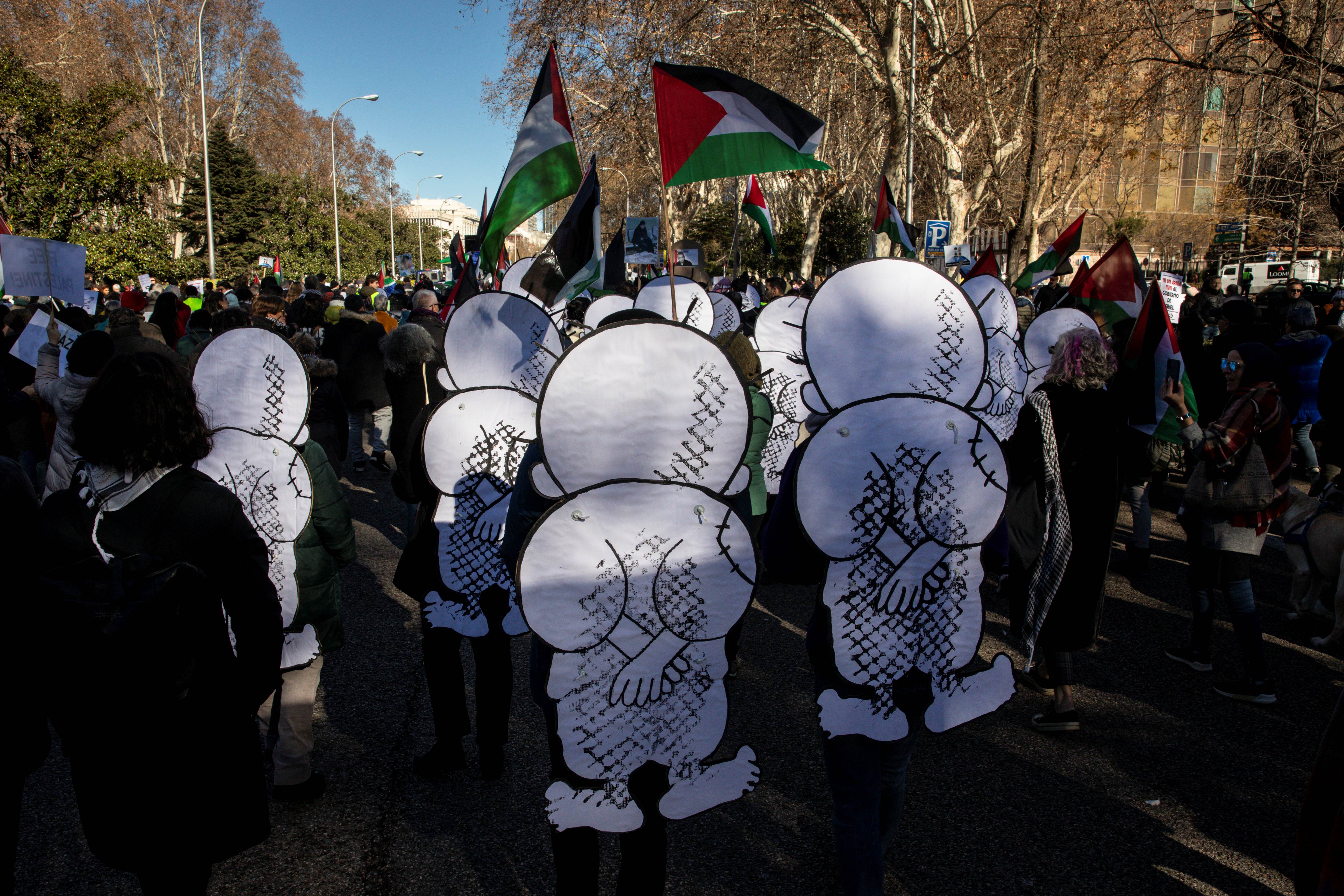
While the Israeli government undertook the marketing of Srulik through magazines, postage stamps, and children’s stories, Arab regimes disowned Handala. He therefore slipped from newspapers onto the walls of camps and streets, until he was immortalised by the assassination of Naji al-Ali in London in 1987, becoming a symbol of a cross-border struggle narrative. Handala appeared in the marches of student movements in Europe and Latin America, and his images were raised on the walls and alleyways of the world, before his name was given to one of the boats seeking to break the siege. All of this confirmed that caricature was never an artistic luxury, but a fundamental part of the media system, upon which the intellectual course of a struggle is built: “Who knows the symbol?” and “How does an image make a political narrative?”